Find what's worth listing next.
Three ways to answer the same question — what should I buy, and will it actually sell? Sweep eBay's sold history, price a supplier list, or shop your own city.
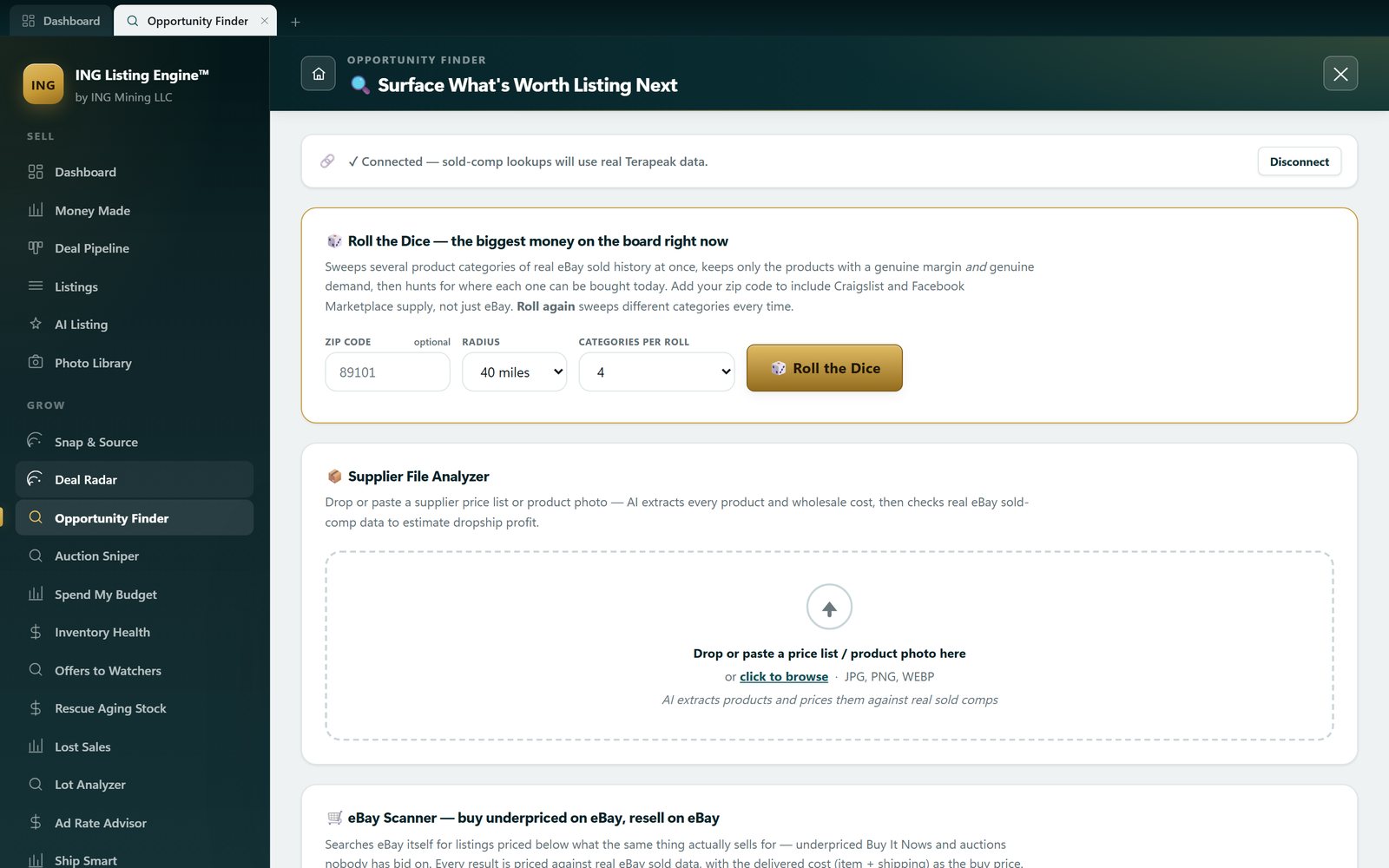
Sourcing blind is the fastest way to end up with dead stock. The Opportunity Finder reads real eBay sold history and tells you where the money actually is — before you buy or list a single item.
What's on the page
- Roll the Dice — you don't need a keyword. It sweeps several product categories of real sold history at once, keeps only the products with genuine margin and genuine demand, then hunts for where each one can be bought today. Roll again sweeps different categories.
- Supplier File Analyzer — drop or paste a supplier price list, or even a photo of one. The AI pulls out every product and its wholesale cost, then checks each against sold-comp data to estimate what's left after fees.
- Local Deals — search Craigslist and Facebook Marketplace by zip code and radius, and compare what locals are asking against real eBay sold prices. Buy local, list on eBay. Craigslist needs no login.
- eBay Scanner — the fourth section on the screen searches eBay itself for listings priced under what the same thing actually sells for, with the delivered cost (item plus shipping) used as the buy price rather than the headline number.
- Ranked by payback speed — results lead with how fast the money comes back, not just gross margin. A $40 item that turns in a week beats a $400 item that sits for a quarter.
There's a fourth place to buy that most sellers walk past: eBay itself. The Auction Sniper points the same arithmetic at live auctions and gives you one number — the most you can bid and still make your margin, after fees and after the seller's shipping. It never places the bid.
Where the numbers come from
Everything here is priced against completed eBay sales, not against what other sellers are currently asking. Asking prices tell you what people hope to get; sold prices tell you what buyers actually paid. Where the sold history is thin, the app says so — a "low confidence" badge instead of a green one — because a median built on four sales isn't a market. We published the ugly version of that problem in full — four live queries where a keyword-matched sold average measures the wrong product entirely, using our own database as the example.
All of this assumes you're at a desk with time to run a scan. When you're standing in front of the thing with the seller waiting, Snap & Source answers the same question from a photo or a pasted link in about a second — same comps, same fee profile, one word back.
Found something worth listing? It goes straight into the AI listing editor, which writes the title, description and item specifics from there.
Local Deals depends on what's posted near you — a rural zip code with a 40-mile radius will return less than a metro one. Facebook Marketplace needs a login; Craigslist doesn't.