The questions people ask before they download.
Twenty-two of them, answered from the code and from published rates rather than from marketing copy. Where the answer is “no”, or “we do not know yet”, it says so — including about our own cost estimate, which is on this page because we think it is wrong.
Money · eBay, safety and your account · Setup and requirements · What it does not do · Help
Money
Is it really free, or is this a trial that expires?
Free, with no clock on it. No card field, no trial countdown, no locked feature. The licence key is compiled into the app and activates on install; the server-side feature gate returns nothing at all, under a comment reading “Freeware — no restrictions”; and if our licence server is unreachable the app deliberately keeps working rather than locking you out of your own listings. All three of those are in the public repository, so this is checkable rather than promised. The one real cost is the AI, and it is not ours to charge for — see the next two answers.
What does the AI actually cost to run?
You bring your own Anthropic Claude API key and Anthropic bills that key directly, at their published rates, with no markup from us and no per-listing fee. Which model does which job is worth knowing, because they are priced an order of magnitude apart:
| Model | What it does in the app | Anthropic's published rate |
|---|---|---|
| Claude Fable 5 | The listing work — reading your photo, writing the title, item specifics and description, and the analysis behind pricing | $10 per million input tokens $50 per million output tokens |
| Claude Haiku 4.5 | Two small jobs: the key check that tells you your key works before you spend five minutes on setup, and the spelling repair that fires when a search comes back empty | $1 per million input tokens $5 per million output tokens |
Rates read off Anthropic's own pricing page on 14 August 2026. They are Anthropic's to change, so check the source rather than trusting this table's age. The key check is a real billed request — one token on the cheap model — because a diagnostic that fakes its answer is worse than no diagnostic.
So how much does one listing cost?
We do not have a measured figure, so we are not going to give you one. This is the answer most software sites get wrong by rounding in their own favour, so here is ours in full, including the part where we disagree with our own app.
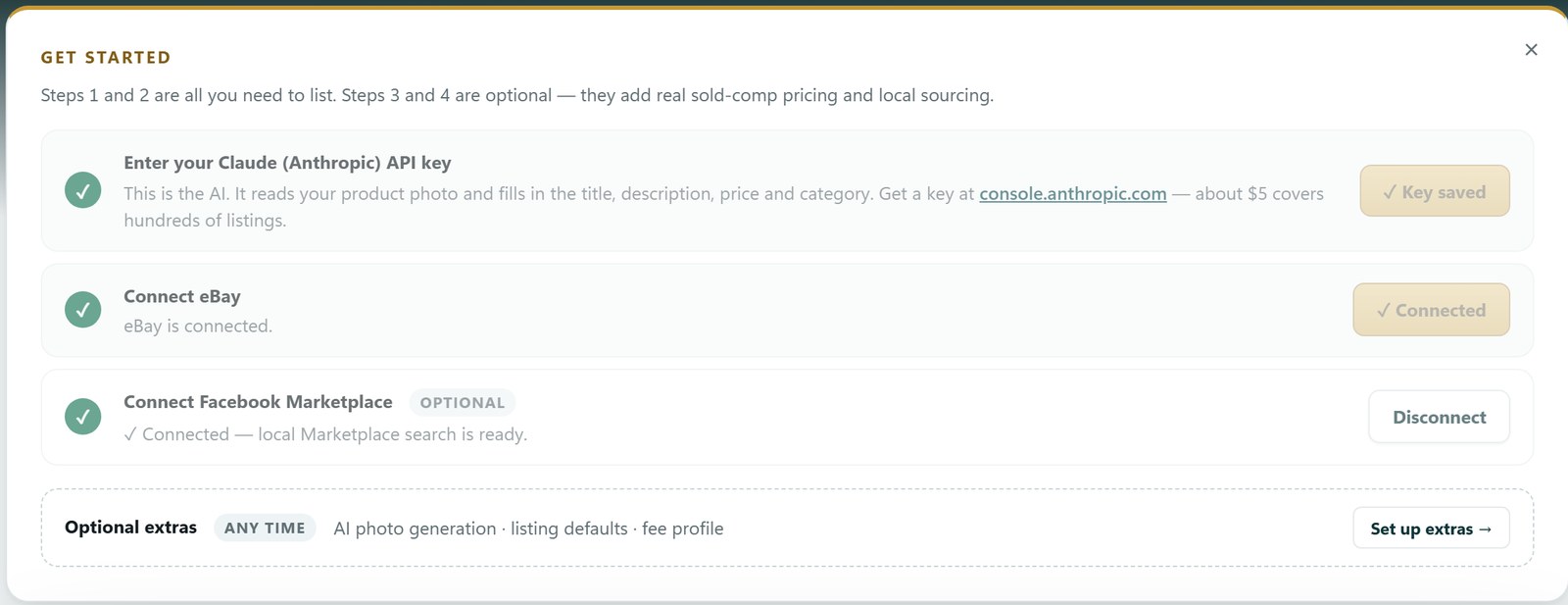
The arithmetic, which you can check: $5 of Claude Fable 5 output is 100,000 output tokens. For $5 to cover hundreds of listings, each listing would have to average a few hundred tokens of output — and a finished listing is an 80-character title, twenty-plus item specifics and an HTML description with a spec table in it. That is bigger than a few hundred tokens before you count the photo you sent, which is charged as input. Plan on the order of dozens of listings per $5, not hundreds.
Then stop taking our word for it, because there is a number that is exact and it is yours: put in your key, do ten items, and read the Usage page in the Anthropic console. Ten minutes of your own data beats any figure we could print, and it accounts for the thing neither of us can guess — how big your photos are and how hard your items are to identify. When we have measured a real batch across a real category spread, the number will be published here with the method attached, the way our sold-comp data is.
That sentence in the app is on the list to fix. It was written before the app moved to the model it runs today, and it now flatters the cost. It is quoted here rather than quietly corrected because a screenshot on a marketing page that has been edited to remove an inconvenient line is exactly the thing this site says it does not do.
Why do I have to bring my own API key? Just charge me.
Because reselling AI access means charging a monthly subscription sized for heavy users and making margin on light ones — everyone listing five items a month subsidises the person listing five hundred. On your own key you pay Anthropic's rate with nothing on top, you can see exactly what you spent in their console, and the key stays on your machine where we never see it. The trade is real, though: it is a second account to create, and it is a bill that arrives whether or not the listing sold.
Priced against five vendors’ subscriptions, bring-your-own-key runs a flat ceiling of about $0.25 a listing and stops winning somewhere above sixty listings a month.
Can I try it without installing anything or getting a key?
Yes. app.inglisting.com runs the whole thing in a browser on any operating system, on our AI key rather than yours — so each account gets five AI generations a day, resetting at midnight UTC. Sign-up is an email address and a password; there is no card field anywhere in it. It exists so you can find out whether the output is any good before committing to a Windows install and an Anthropic account.
Will it stay free?
No price has been set and none has been announced. Anyone telling you software is guaranteed free forever is guessing, and we are not going to do that. When there is a decision it will be stated on the changelog before anything changes. Note that your Anthropic key is unaffected either way — it is billed by Anthropic, not by us, so it does not stop working because our pricing does.
eBay, safety and your account
Does eBay allow third-party listing software?
Yes, and this is the sanctioned route rather than a workaround. Publishing goes through eBay's official Sell API, authorised with eBay's own OAuth flow against a developer keyset in your name. Nothing scrapes eBay's website and nothing drives a browser pretending to be you. Sellers have used bulk listing tools since File Exchange and Turbo Lister, and eBay ships its own AI description feature — the category is not a grey area. One honest gap: we are not in eBay's third-party provider directory and competitors such as Vendoo are, which is a real difference in how vetted the two look from outside. That comparison is on the Vendoo page, not buried here.
Do I type my eBay password into the app?
No, and there is nowhere to. Clicking Connect eBay opens eBay's own sign-in page in your browser; you sign in on eBay's domain and eBay hands the app a token. The app never sees the password, and you can revoke that token from your eBay account settings at any time without uninstalling anything. The full walk-through is in the setup guide.
Do I need my own eBay developer account?
For the Windows download, yes — the installer ships with an empty Client ID rather than borrowing ours. You create a free eBay developer account and paste your own Client ID, Client Secret and RuName into Settings → eBay → Advanced. New keysets start sandbox-only, and production access is a support ticket eBay typically turns around in one to three business days. That wait is the longest part of setup, we cannot speed it up, and it is the reason the browser version exists.
What data leaves my computer?
Your eBay tokens and API keys sit in a credentials file on your own PC and go to no third-party server; your listings, photos and imported inventory live in a local database. Two things do leave, both on purpose. What you send the AI — the item text and the photo you asked it to read — goes to Anthropic on your key, which is the entire point of the feature. And a sold-comp lookup sends the search term to our server, while your listings, photos, keys and tokens do not. The connections page is the canonical account of which connection does what, and the privacy policy is the formal one.
Will an AI-written listing get my account penalised?
There is nothing in eBay policy against a listing being drafted by software, and eBay publishes its own AI description tool. What matters is that the listing is accurate — and that is on you, which is why nothing publishes without your approval. One hard line, and it is ours rather than a suggestion: never let AI generate the listing photograph. A generated picture of an item you are selling is fabrication and it breaks eBay policy. The photo tools in the app clean up, crop and background-remove your real pictures of your real item; the illustration at the top of this page is marketing art and would never belong on a listing.
Can it publish listings without me seeing them?
No. Every draft lands in an editor with every field editable, and nothing is scheduled to go live on its own. There is one thing it does before you get there: it asks eBay whether it will accept the listing at all — category, item specifics, business policies — so a rejection surfaces at the start rather than after you have spent five minutes writing. What to fix when it comes back unhappy is a page of its own.
Setup and requirements
What do I need to run it?
Windows 10 or 11, an eBay seller account, and an Anthropic Claude API key. The installer is about 51 MB. Windows may show a SmartScreen warning, because the installer is not code-signed yet — choose More info → Run anyway. When it starts, your browser opens at localhost:9332: that address is the app, running on your own machine, not a website. The setup guide walks the whole thing end to end, and the changelog is the honest list of what is in the download versus what is only in the source.
Does it run on a Mac?
The download does not. It is a Windows desktop application; there is no Mac build and no phone app, and there is no point pretending one is coming next month. The browser version runs on macOS, Linux, a Chromebook or a tablet, with the five-a-day AI allowance described above.
Do I need an eBay Store subscription?
No. It works on a plain seller account with the free listing allowance, and it does not care which tier you are on. Whether a Store pays for itself is a genuinely separate question about your listing count and category, and it is worked through with real fee arithmetic in does an eBay Store subscription pay for itself.
How long does setup actually take?
Two steps are all you need to list: the Claude key, which takes about two minutes, and Connect eBay. Everything else — Terapeak, Facebook Marketplace, listing defaults, the fee profile — is optional and can wait until you have a reason. The one thing you cannot compress is eBay granting production access to your keyset, which is why it is worth applying for that on day one and exploring the app while you wait.
What it does not do
Does it cross-list to Mercari, Poshmark or Facebook Marketplace?
No, and this is the biggest thing it does not do. It exports files you can upload elsewhere, but it posts to no other marketplace and detects no sales on them — which means it cannot delist an item you have just sold somewhere else, the single job a cross-lister exists to do. If that is your actual bottleneck, pay Vendoo or List Perfectly. Both pages say where those tools beat this one, because sending you to the right software is worth more than winning the click.
Does it work on eBay UK, Australia or other non-US sites?
It targets eBay US. The Sell API integration, the category tree, the sold-comp database and the fee arithmetic are all built around ebay.com. If you sell mainly on ebay.co.uk or ebay.com.au, this is not your tool today.
What kind of seller is it worst for?
Apparel and soft goods. It is built by hardware sellers for hardware: miners, servers, industrial automation, graphics cards, network gear, bench tools — items with a model number, a spec sheet and a thin, hard-to-read comp set, where getting the item specifics right is most of the job. A clothing seller listing forty shirts a day wants a cross-lister with a phone camera app, which is a different product and we will not pretend otherwise. What the AI can and cannot read off a photograph is set out in building a listing from one picture.
If I stop using it, is my data stuck inside it?
No. Your listings live on eBay, where they already were. The app's own database is a SQLite file on your machine, the export tools write plain CSV, and uninstalling takes nothing off eBay and holds nothing hostage.
Help
Where do I get help or report a bug?
Bug reports go to GitHub issues, where they are tracked in public, or by phone and email through the contact page. Set your expectations accordingly, because we would rather you did that now than after you have waited a weekend: this is one person, not a support team, and there is no seven-day phone line for the software.
Something on this page is wrong. Now what?
Tell us and it gets corrected with the date on it, which is how the cost answer above ended up being written the way it is. Every page here carries a byline for the same reason — one named person has to answer for it. If you would rather read the arguments than the answers, every guide is indexed by topic.