
ING Listing Engine writes to exactly one place on the internet: your eBay account. Everything else it touches, it reads — or it hands you a file and gets out of the way. That distinction is the whole page, and most integrations lists in this category blur it deliberately.
So here is the map: nine outside services, sorted by how much power each has over your account, plus the ones people assume connect and don’t. If you’re evaluating AI eBay listing software and want to know what it can do behind your back — to eBay, quite a lot once you sign in. Everywhere else, nothing.
The whole map, in one table
| Service | What it does | What it needs from you |
|---|---|---|
| eBay | Reads your listings and orders, publishes, revises, ends, sends offers | OAuth sign-in on eBay’s own page |
| Anthropic (Claude) | Writes the titles, specifics and descriptions | Your own API key. This is the only bill |
| Terapeak | Reads sold comps from eBay Seller Hub | Optional. Browser sign-in to your own eBay account |
| Facebook Marketplace | Reads local supply near your zip | Optional. Browser sign-in to your own Facebook account |
| Sold-comp API | Answers price lookups from 864,000 completed sales | Nothing. Pre-configured in the installer |
| Craigslist | Reads local for-sale and free listings | Nothing. No account exists to make |
| Slickdeals, DealNews, TechBargains | Reads public deal feeds for retail arbitrage | Nothing. Plain public RSS |
| HiBid | Reads liquidation and business-closure auction lots | Nothing |
| GitHub | Checks every six hours whether a newer build exists | Nothing |
Two are required, two are optional sign-ins, five need nothing at all. Nothing on the list posts, bids, messages or buys.
eBay is the only connection that writes
You sign in through eBay’s own OAuth page — your password is typed into eBay, never into this app — and the app asks for five permissions: general access, sell.inventory, sell.account, sell.fulfillment and sell.negotiation. That last one is the newest, which is why sellers who connected before Offers to Watchers shipped get told to reconnect instead of hitting a silent failure.
With those it creates and publishes offers through the Inventory API, reads the business policies eBay requires on every listing through Account, pulls orders through Fulfillment, sends offers to watchers through Negotiation, picks a category through Taxonomy, and falls back to the older Trading API for the XML-only calls with no modern equivalent. A sandbox toggle swings all of it to eBay’s test environment. What the first sync pulls down is on the connected store page.
One thing to know before you rely on it: eBay’s refresh token expires and eBay will not renew it on its own. The app warns a month out, and when it lapses there’s no automatic recovery — you sign in again, and nothing else works until you do.
The eBay Scanner is the exception. It searches eBay with an application token rather than yours, so you can install the app, price things, and never connect an account at all.
Your Claude key is the only bill
The app is free during the beta with no card to enter, because the AI isn’t ours to resell. You paste an Anthropic API key and pay Anthropic directly, metered, unused credit staying yours. Drafting runs on Claude Fable 5; cheap background jobs — validating your key, spell-checking a search box — run on Haiku 4.5. The real downside is that it’s a second signup and a second bill. If you’d rather one company charged one price for everything, a subscription tool fits you better.
Two sign-ins that read as you, in your own browser
Terapeak and Facebook Marketplace share a problem: neither publishes a usable API. Terapeak is a logged-in page inside eBay Seller Hub. Facebook Marketplace has no public search API at all — not a restricted one, none. So both work the same way. The app opens one real, visible browser window, you log into your own account there, and it saves that session to reuse.
The posture is identical on both and deliberate: user-driven only, nothing on a timer, one search equals one page load, no crawling, no bulk export. Facebook never posts, never messages, never acts as you. And a dead session is reported rather than silently re-authenticated — because quietly re-logging into someone’s Facebook in the background is exactly the behaviour you should refuse to install. Both are optional; skip them and the app still drafts, prices and publishes.
What it reads without asking anyone’s permission
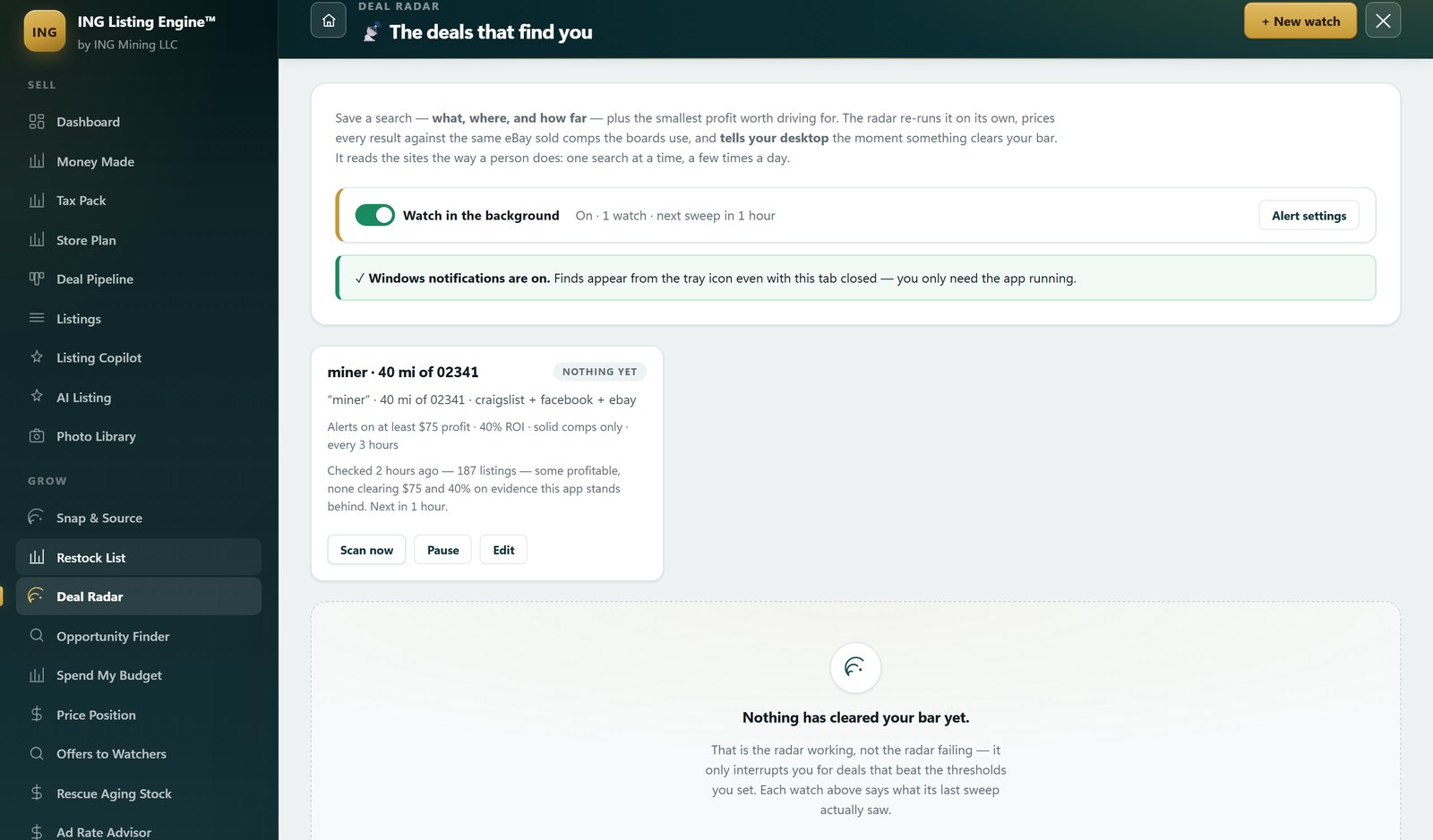
Craigslist needs no account because there isn’t one to make. Slickdeals, DealNews and TechBargains publish plain public RSS. HiBid is the aggregator the closing businesses themselves list on, and it publishes each search as machine-readable state including the buyer’s premium — the cost line that quietly ruins auction arithmetic.
Three obvious names are missing, and the reason is in the source: liquidation.com, B-Stock and Direct Liquidation were all tried and all refuse automated requests. liquidation.com answers a bare 403 on every path; B-Stock serves a Cloudflare interstitial. Building a source on a block page ships a permanently broken chip, so they appear as one-click prefilled searches you open yourself — a smaller promise, and one the app can keep.
The sold-comp API deserves a caveat rather than a bullet. It’s ours, it’s pre-configured in the installer, and it holds the 864,000 completed-sale records — the same store this site publishes as tables and a CSV. Which means the words you type into a price lookup leave your machine and reach our server. Your listings, photos, keys and tokens don’t — those sit in a folder under your own user profile — but the search term does. No tool that prices against a shared database is fully offline, and you should hear that from us rather than work it out later.
Cross-listing is an export here, not an integration
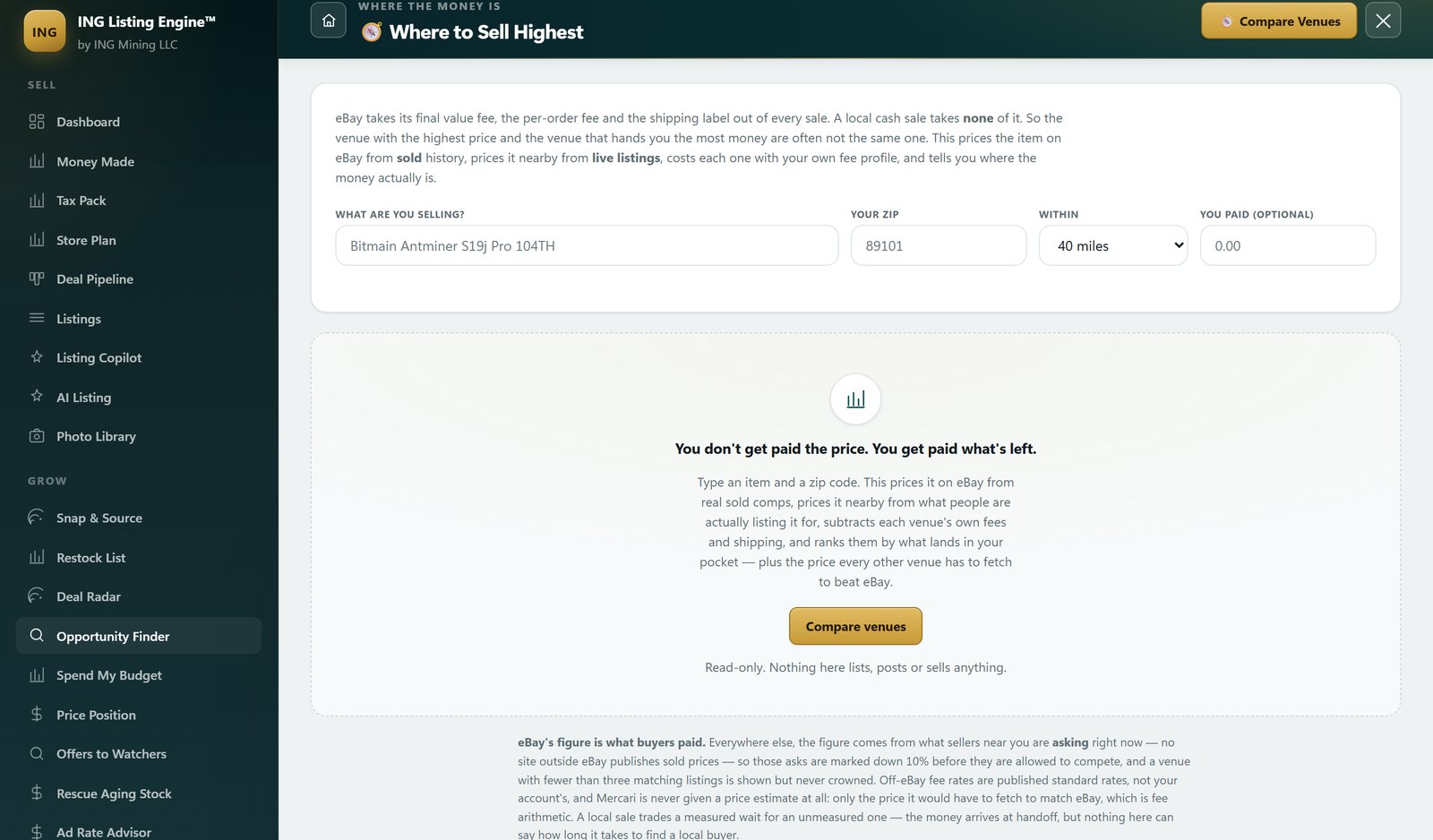
The app turns a finished eBay draft into ready-to-post listings for Facebook Marketplace, Mercari and Amazon. It does not post them. It cuts the title to each site’s limit — 100 characters on Facebook, 80 on Mercari, 200 on Amazon — strips the eBay mentions every other marketplace bans in listing text, folds eBay’s structured item specifics into the description because no equivalent field exists there, and re-derives the price at net parity: whatever leaves you the same take-home after that site’s fees.
Then it says what happens next, per marketplace. Facebook’s Commerce Manager reads the generated CSV directly. Amazon’s columns match the Inventory Loader flat file. Mercari has no public bulk importer, so there the CSV is a worksheet and the copy buttons are the real path — stated in the app itself, so nobody uploads it and waits. Calling that an integration would be a stretch. It’s a well-prepared export.
What it does not connect to at all
Poshmark, Depop, Etsy, Grailed, Vestiaire Collective, Whatnot, Vinted, Shopify, Instagram and Amazon’s Selling Partner API. No plans on any of them.
If genuine multi-marketplace reach is your problem, buy a tool built for it. List Perfectly covers nine marketplaces from $29 a month and runs on a Mac; Vendoo is the other serious answer. Both beat this app at that job on any day you care to test it, and no amount of integration copy from me changes it. This app is for the other question — what one eBay listing should say, and what it should cost.
One more, because it exists and is switched off: image generation, with two optional backends — OpenAI’s image API, or a local Stable Diffusion server on your own machine — behind a setting that defaults to disabled. Leave it that way for listing photos. eBay expects the picture to be of the actual item you’re selling, and a generated one isn’t.
When a connection breaks, it’s one of five things
Most software collapses every connection failure into one grey “disconnected” chip, which is how a two-second network blip and a dead login come to look identical. This app runs a real end-to-end check instead — a live token refresh, an authenticated API call, a headless replay of each saved session, an actual query to the comps API — and returns one of five states, each with a different fix.
| State | What it means | What fixes it |
|---|---|---|
| Not configured | Never set up — no credentials stored | Set it up |
| No session | Configured, but sign-in was never finished, or it failed | Sign in, using the recorded reason it failed last time |
| Session expired | It worked once, and the sign-in has since died of old age | A fresh sign-in. Nothing else |
| Auth rejected | Credentials were presented and refused right now | A revoked grant needs a reconnect; a 4xx on the token endpoint usually means the client secret no longer matches |
| Unreachable | Nothing wrong with your credentials — the other end didn’t answer | Wait. Re-authenticating fixes nothing here |
The last row earns its keep. A 5xx from eBay and a revoked token produce the same empty screen, and only one is worth your afternoon. One deliberate subtlety: a “verify you’re human” challenge on a saved browser session is not counted as a dead login, because treating it as one is how a perfectly good session gets thrown away. The check launches two headless browsers, so it’s slow — a “why is this broken” button, not a status light.
Common questions
Does ING Listing Engine need my eBay API keys?
No. You click Connect eBay, your browser opens eBay’s own sign-in page, and eBay hands the app a token — your eBay password never touches this app. There are Client ID and Secret fields in an advanced section for people running their own eBay developer application or the sandbox, and almost nobody needs them.
Can it list to Mercari, Poshmark or Amazon?
It publishes to eBay only. For Facebook Marketplace, Mercari and Amazon it generates a ready-to-post listing with the title cut to each site’s limit and the price recalculated to net you the same money after fees — but you paste or import it yourself. Facebook and Amazon accept the generated file; Mercari has no bulk importer, so there it’s a worksheet. Poshmark, Depop, Etsy, Grailed and Whatnot aren’t supported in any form.
Does it work offline?
No, and be careful with anyone who says their listing tool does. Drafting needs Anthropic, publishing needs eBay, and price lookups query our hosted sold-comp API, so the keyword you search leaves your machine. Everything else stays local: your listings database, photos, API key and eBay tokens all live in a folder under your own user profile.
What happens to my connections if the free beta ends?
The eBay connection is between you and eBay under your own OAuth grant, and the Claude key is your account with Anthropic — neither is ours to switch off. What could change is the hosted sold-comp API, the one piece running on our server. The pricing page says plainly what is and isn’t promised after the beta.
Is there an API or a Zapier integration for ING Listing Engine itself?
Not a supported one. The app serves its own interface on localhost port 9332, so endpoints exist and a determined person will find them — but they’re undocumented, unversioned and not stable between builds. Building on them today means something breaks on an update you didn’t choose.
If you’re on Windows, sell on eBay, and the list above covers what you need, the download is free during the beta — bring your own Claude key and that bill is the only cost. The setup guide connects each of these in order.
Filed under Inside the App · Tagged Automation, Sold comps · Browse all guides by topic