
Before you pay for a Terapeak alternative, know what you’re replacing: Terapeak Product Research is free with any eBay seller account and gives you three years of real sold prices, including accepted Best Offer amounts. Almost nothing you can buy beats that on raw historical depth. The paid tools win on different things — live listings, competitor tracking, non-eBay marketplaces — and on one thing nobody advertises, which is letting you filter the comp set yourself.
That last one is the real reason most sellers go looking. It’s not that Terapeak’s data is wrong. It’s that any sold-price average built from a keyword search is measuring a pile of items you didn’t ask about. Below is that failure demonstrated on our own 864,000-row sold-listings database — because it’s easier to show you the problem in a dataset we control than to make claims about someone else’s.
What Terapeak actually gives you in 2026
Worth getting straight, because a lot of “Terapeak alternative” content is still describing the 2019 paid subscription:
- Product Research — free to every seller with a Seller Hub account. No store subscription. Up to three years of transaction-level sold data, with the price actually accepted on Best Offer listings, which public completed-listing search will never show you.
- Sourcing Insights — the category-level demand tool. This one needs a Basic Store subscription or above, from about $21.95/month in the US.
- Mobile — it’s in the eBay app under Seller Tools now, so you can scan a barcode at an estate sale and get three years of history standing in the driveway.
Three years of first-party transaction data, free, is a genuinely strong offer. If you sell mainstream catalogued goods — phones, sneakers, cameras, game consoles — Terapeak is probably better than whatever you were about to pay for, and the honest advice is to keep using it. The rest of this page is about the cases where it isn’t enough.
The problem no research tool advertises: keyword matches are dirty
Every sold-comp tool starts with a keyword search. You type a model number, the tool matches listings whose titles contain your words, and it averages what those listings sold for. That average is only as good as the match — and the match is usually terrible.
Here’s what that looks like in practice. We keep our own sold-listings database — 864,000 rows scraped from completed eBay listings, collected through 17 July 2026 — which powers the pricing side of ING Listing Engine. We ran four queries against it and pulled a 500-row sample of each. This is our data failing, not Terapeak’s:
| Query | Rows “matched” | Average over all matches | Actually the right item, in a 500-row sample |
|---|---|---|---|
dell poweredge r740 |
30,289 | $294.86 | 0 |
thinkpad t480 |
10,906 | $357.37 | 18 (3.6%) |
cisco catalyst 9300 |
203 | $876.62 | 2 |
antminer s21 |
1,917 | $637.93 | 19, of which 1 was a whole miner |
Take them one at a time, because the failure mode is different each time.
Dell PowerEdge R740: 30,289 matches, zero servers
Not one row in the 500-row sample had both “poweredge” and “r740” in the title. The sample was Dell laptop backpacks, EcoLoop carry cases and D3100 docking stations. The word “Dell” did all the matching work. That $294.86 average is the price of a laptop bag, and a tool that showed it to you next to the words “average sold price” would be lying with a straight face.
Cisco Catalyst 9300: an average built from a hiking backpack
Only 203 rows matched at all, and the average across them was $876.62 with a top row at $29,250. Two of those 203 were actually Catalyst 9300 switches: a 9300L-24P-4X-E at $725 and a C9300-48U-A with dual power supplies at $900. The other 201 included ULA Catalyst ultralight backpacks, a Mystery Ranch Catalyst 22, several Lenze EVS93xx servo drives (the “9300” series), and a restored vintage Coach Companion bag, model 9300.
The two real switches average $812.50. The keyword figure of $876.62 lands within 8% of that — which sounds fine until you notice it got there by averaging hiking backpacks against a $29,250 outlier. It’s a right answer produced by a broken method, and next query it won’t be.
Antminer S21: the parts problem
This is the one that costs money, and it’s the failure I hit personally, because ASIC miners are a category I actually sell — there’s a whole page on pricing and listing bitcoin miners on eBay if that’s your category. Nineteen rows in the sample were genuinely Antminer S21 listings. Eighteen of them were not miners:
- Nine hashboards, $200 to $1,260 — and the range itself is noise: the cheapest was an S19 XP board that only mentions S21 in passing, the dearest was two boards sold with a control board
- Four control boards, $38 to $164.99
- Four lots — 5, 6, 10 and 30 units — from $3,000 to $9,597
- One hashboard repair service, $359.46
Exactly one row was a complete single machine: a Bitmain Antminer S21 195Th at $999. Meanwhile the off-target rows were Samsung Galaxy S21 phones and earbuds, a Garvee SAC12-2-S21 mini-split air conditioner, a Notch Marvin S21 pole saw blade and a Kriwan motor protector.
Price a used S21 off a “$637.93 average” and you’ve listed a working miner at hashboard money. Price it off the $3,000 lot row and you’ve listed a single unit at the price of five.
ThinkPad T480: the one that nearly works
The best of the four, and still not good. 18 of 500 rows were real T480s or T480s models. Strip the parts listings and 16 remain, median $197.87, running $135 at the 10th percentile to $350 at the 90th — an i5/8GB machine versus an i7/16GB one, which is a spread you can reason about. The database’s headline average for that query was $357.37. That’s an 81% overstatement on the single most important number in the listing.
So what actually fixes it
Three things, in order of how much they help:
- Filter to the model, not the keywords. Require every model token in the title. That single rule took the T480 set from 500 rows of noise to 18 rows of laptops.
- Split parts and lots out — don’t just delete them. They’re real market data for a different product. A tested S21 hashboard at $449 is a legitimate comp for a hashboard.
- Use the median, and look at the spread. One $29,250 outlier destroys a mean. It barely moves a median. And if the 10th and 90th percentiles are miles apart, that’s not noise, that’s the spec range — go read the actual titles.
Terapeak lets you do some of this. You can filter by condition and category, and in catalogued categories eBay’s own product matching does the model-token job for you far better than a keyword search ever will — that’s Terapeak’s real advantage and it’s a big one. Where it falls down is uncatalogued gear: industrial parts, ASICs, enterprise networking, anything with an OEM part number and no eBay catalogue entry. There, you’re back to a keyword search, and you need the rows.
The Terapeak alternatives, honestly rated
| Tool | Cost | Genuinely better than Terapeak at | Worse at |
|---|---|---|---|
| ZIK Analytics | $1 trial, then ~$19.99–$39.90/mo | Live listings and 7/14/30-day performance, competitor/seller tracking, title building. If you want to know what’s selling this week, this is the category leader. | Historical depth. It’s a third-party view of eBay, not eBay’s own transaction record. |
| eBay advanced search, “Sold items” | Free | Nothing beats it for a quick sanity check, and it’s the fastest way to eyeball actual titles — which, per everything above, is what you should be doing anyway. | ~90 days, no Best Offer prices, no aggregation, no export. |
| eBay Marketplace Insights API | Free if approved | It’s the real thing — first-party sold data, programmatic, filterable however you like. | It’s a Limited Release API. Individual sellers and small developers are routinely refused, and it only goes back 90 days. Apply anyway; don’t plan around it. |
| WorthPoint | Paid subscription | Antiques, collectibles and one-of-a-kind items, with sale history going back far further than three years across multiple auction houses. | Useless for modern commodity electronics. |
| Your own scraped comp database | Time, or a tool that does it | You own the rows, so you can apply every filter above. Nothing else lets you exclude hashboards. | It’s a scrape, not eBay’s ledger. No Best Offer prices, coverage gaps in thin categories, and it goes stale the day you stop collecting. |
Notice what’s not on that list: a tool that replaces Terapeak outright. There isn’t one, and any page telling you otherwise is selling something. The correct setup for most sellers is Terapeak plus one thing that covers its blind spot.
Which blind spot is yours
- You sell catalogued mainstream goods. Stay on Terapeak. Add ZIK only if you’re chasing trends rather than sourcing what’s in front of you.
- You sell uncatalogued technical gear — servers, PLCs, teach pendants, ASICs, networking. Terapeak’s keyword mode will mislead you the way our database did above. You need row-level filtering.
- You buy in lots and pallets. Every comp source will blend single units and lots into one average. That’s the single most expensive mistake in this whole article.
- You’re pricing 80 live listings, not researching one item. No research tool is built for this. That’s a repricing job — see eBay repricing software.
- You sell outside eBay too. Terapeak is eBay-only by definition. Nothing to argue about.
How we handle it in ING Listing Engine
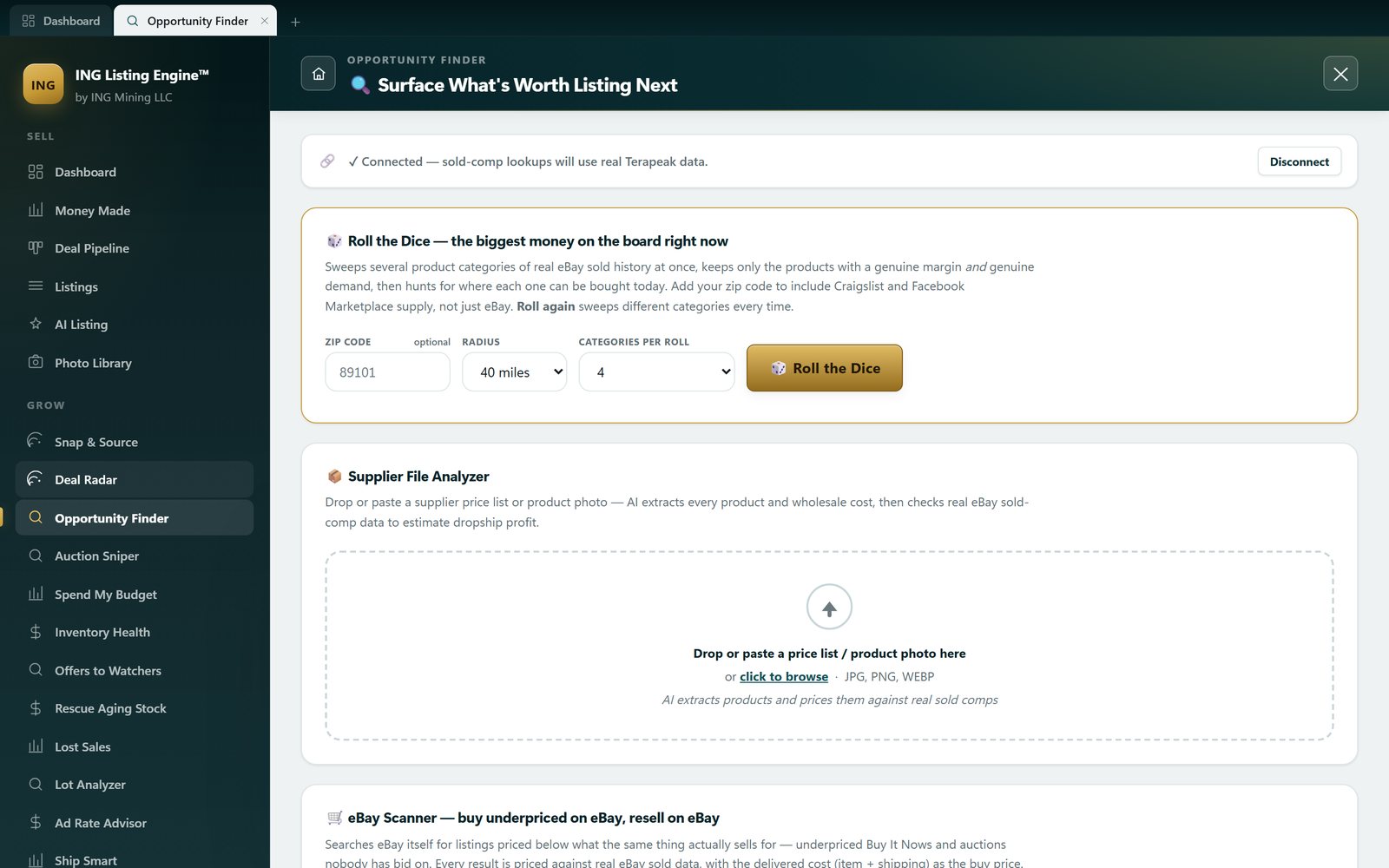
The app carries the sold-comp database described above and applies the three rules from this page automatically: model-token matching, a parts-and-lots split, and median-with-spread instead of a mean. The Opportunity Finder then scores live listings against those cleaned comps by estimated profit after fees, ranked by how fast the money comes back rather than by gross margin.
The honest limits, since this page is about being straight with you:
- It’s a scrape of completed listings, not eBay’s ledger. Terapeak’s three years of first-party data is deeper and more authoritative. We don’t have accepted Best Offer prices at all.
- Coverage is uneven. Categories nobody has collected yet return thin results, and the app flags low-confidence estimates rather than pretending.
- The snapshot above runs through 17 July 2026. A live database beats a snapshot.
What it’s better at is exactly one thing: you get the filtered rows, for uncatalogued technical gear, without paying a subscription. That’s the whole pitch. Download ING Listing Engine free and run a comp lookup on something you already own — it’s in open beta, no paywall, no card.
The same cleaned comps drive the buy side too: the maximum-bid math behind eBay auction sniping is this page’s argument turned into one number per live auction — and it shows what happens when the comp basis is too thin to trust.
Related reading: AI eBay listing software covers how the cleaned comps feed into a generated listing, and writing an eBay listing from one photo walks through the identification step that has to happen before any comp lookup can work.
Common questions
Is Terapeak still free in 2026? Yes. Terapeak Product Research is included with any eBay seller account through Seller Hub, with up to three years of sold data. Sourcing Insights is the part that needs a Basic Store subscription or above.
What is the best free Terapeak alternative? eBay’s own advanced search filtered to sold items. It’s about 90 days deep and won’t aggregate anything for you, but it shows real titles, which is more useful than a wrong average. Beyond that, free alternatives are mostly trials.
Is ZIK Analytics better than Terapeak? For live listings, weekly sales velocity and competitor tracking, yes — genuinely. For three years of first-party sold history, no, and it costs money where Terapeak doesn’t. They answer different questions.
Why do sold-price averages come out so wrong? Because they average a keyword match. In our own database a search for “dell poweredge r740” returned 30,289 rows and not one of the 500 we sampled was a PowerEdge R740. Always check the titles behind the number.
Can I get eBay sold data through the API instead? The Marketplace Insights API returns sold items programmatically, but it’s a Limited Release requiring eBay approval that small developers are frequently refused, and it only covers 90 days. Worth applying for; not worth depending on.
How do I stop lots from wrecking my pricing? Exclude titles containing “lot of”, “bundle”, “pallet” and unit counts before you take any average, then price lots as their own product. In our Antminer S21 sample, four lot listings ranging from $3,000 to $9,597 sat in the same result set as $38 control boards.
Method, so you can check it
Every figure on this page came from four queries run on 27 July 2026 against our hosted sold-comps API (table ing_sold_listings, 864,000 rows of completed eBay listings, collected through 17 July 2026). For each query we requested the aggregate over all matches, then pulled a sample capped at 500 rows and counted how many titles contained every model token. “Parts and lots” were split on a title-word rule covering hashboards, control boards, power supplies, screens, boards, spares and lot/bundle/pallet language. Medians and percentiles are over the cleaned set. Nothing here is estimated, rounded for effect, or reused from the earlier Antminer S19 analysis on our listing-software page — these are separate queries with separate results.