

If you source catalogued goods to flip — phones, consoles, sneakers, anything with a model number a thousand other people are also selling — pay ZIK Analytics and stop reading. It is $39.90 a month, it tracks nine eBay marketplaces, and it answers the question it was built for: what is moving right now, who is selling it, and at what price.
This page is for the other person typing ZIK Analytics alternative: the one whose inventory is a FANUC teach pendant, a variable-frequency drive and a shelf of used server parts, who signed up, ran a search, and got a shrug. I sell that kind of gear. Below is what I found when I counted how many sales actually exist inside the window a research tool has to work with — and the answer is why no subscription was ever going to help. If you want the whole field rather than this one brand, that lives on our research-tool comparison.
I have not run ZIK, so I am not going to tell you what it returns for an Allen-Bradley drive. Every ZIK figure here was read off their own pages on 11 August 2026 and linked. What I can measure is the raw material — how many completed sales exist for these items at all. If the sales aren’t there, no tool finds them.
What ZIK Analytics costs, and what the plans cap
Read off zikanalytics.com/pricing on 11 August 2026, eBay plans, monthly billing. Both tiers advertise a $1 trial, and both are cheaper paid annually.
| Plan | Monthly | What it includes and what it caps |
|---|---|---|
| Pro | $39.90 | Chrome extension, unlimited competitor / product / category research, Bulk Scanner, Turbo Scanner, Autopilot, 500 Best Selling Items, Title Builder, Market Insights. 20 Product Explorer searches a month. |
| Pro+ | $59.90 | Everything above, plus unlimited Bulk Scanner, 10 Turbo Scanner searches and 10 Autopilot listings a month, unlimited Best Selling Items, and 100 Product Explorer searches a month. |
Prices move and mine will go stale. Check the page before you quote me. If you want the category-wide picture rather than one vendor, the five pricing models this market uses are laid out in what listing software actually costs.
Five things ZIK does that we have no answer to
Not hedged. These are real gaps, and if any one of them is your job, this comparison is already over.
- Nine eBay marketplaces. US, UK, Australia, Canada, Germany, France, Italy, Spain and Singapore. We read eBay.com and nothing else. If you sell into eBay.de or eBay.co.uk, we are not a candidate.
- Competitor research. Point it at a seller and get their revenue, active listings, sold items, average price and sell-through in one view. We have nothing that looks at another seller’s whole store.
- Supplier sourcing. Amazon, Walmart, AliExpress, Alibaba and CJ Dropshipping into eBay, with the margin gap computed for you. Our Supplier File Analyzer reads a price list you already have; it does not go and find you a supplier.
- Shopify, entirely. AdSpy, Sales Tracker, Store Finder. We are an eBay tool and that is the whole product.
- Title Builder and keyword volume. ZIK sells search-volume data for eBay keywords. Our titles are written from the sold comps of that one item, which is a different and narrower thing.
Every research tool assumes your item sells often. Most of mine don’t
ZIK’s eBay tools report demand over a recent window — sell-through rate, successful listings, sales over 7, 30 or 90 days. Terapeak does the same. So do we: our own Rising-Demand Radar compares the last 45 days against the 45 before them, which you can see in the dropdown here.
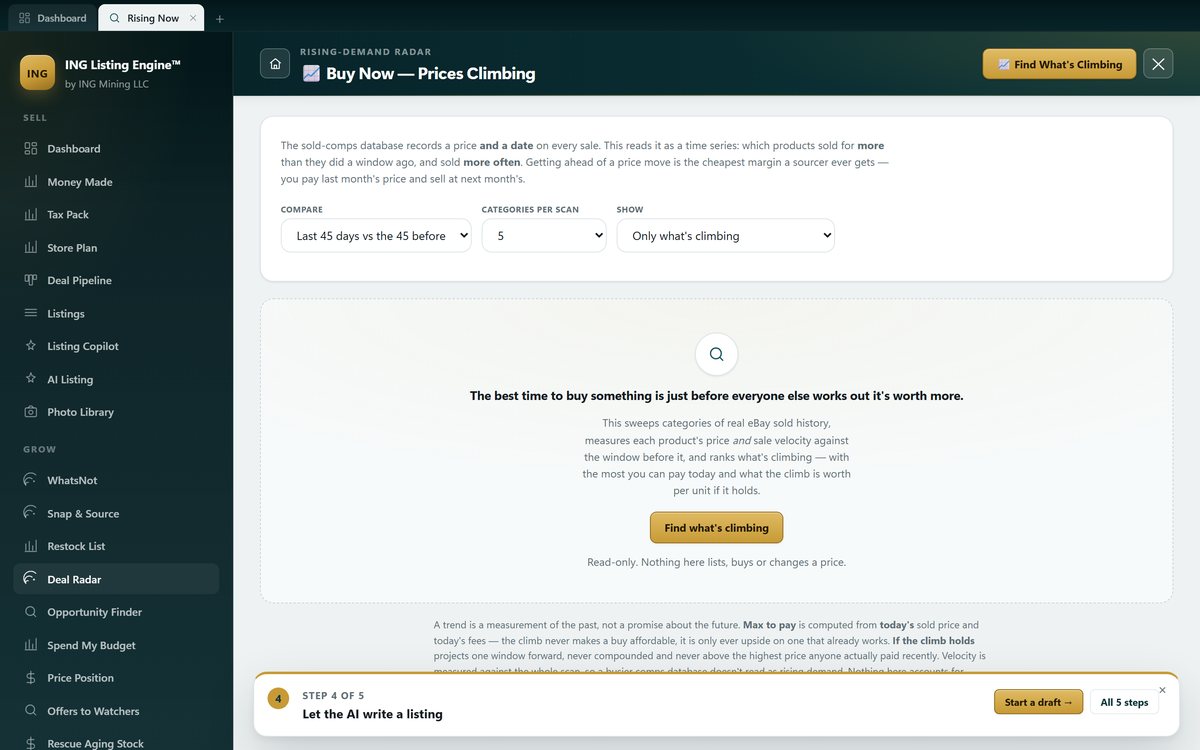
A window is not a neutral choice. It is a bet that the thing you are holding sells often enough for a recent slice of time to contain any sales at all. For an iPhone that bet is free. For an uncatalogued industrial part it is the whole problem, and the honest output is silence rather than a number built on one sale.
I counted the sales inside a 30-day window for the gear on my own shelf
The source is our own harvest of completed eBay sales — 897,135 rows collected between 16 July and 7 August 2026, published in full at eBay sold listings data, licence and method included. It is a keyword harvest, not a census of eBay, so every count below is a lower bound on real sales.
For each item I took the complete result set, threw away every row whose title does not literally contain the model or part number, and then counted the busiest real 30-day window — not a rate, not an average, an actual count of sales in the fullest 30 days on the calendar. The script is tools/run66_window_study.py.
| Item | Sales found | Busiest 30 days | Busiest 7 days | Sellers |
|---|---|---|---|---|
| FANUC A05B-2301-C315 pendant — the one I have | 1 | 1 | 1 | 1 |
| FANUC A05B-2301 pendants, any configuration | 31 | 15 | 6 | 28 |
| Allen-Bradley PowerFlex 525 25B-D6P0N104 | 1 | 1 | 1 | 1 |
| Allen-Bradley PowerFlex 525, any drive | 7 | 4 | 3 | 5 |
| Allen-Bradley PowerFlex 4M 22F-D2P5N103 | 0 | 0 | 0 | 0 |
| Apple AirPods Pro, 2nd generation | 144+ | 139 | 61 | 106 |
| Nintendo Switch OLED console | 377+ | 344 | 334 | 326 |
| NVIDIA Quadro P2000 | 252+ | 182 | 55 | 171 |
+ hit the 500-row query cap, so those three are lower bounds and the real figures are higher, which cuts against the argument and belongs here anyway. A keyword harvest is not a census of eBay, so every count is a floor.The bottom three rows carry a + because the query caps at 500 rows, so those are samples and the real numbers are higher — which cuts against my own argument and belongs in the table anyway.
For an AirPods Pro, a 30-day window holds 139 sales from 106 different sellers. A sell-through rate computed on that is a real measurement, and this is exactly the ground ZIK is built for. For the pendant sitting in my workshop, the busiest 30 days on record contain one sale — not one a week, one, in the fullest month of a seven-month span. No window width turns that into a trend.
The Quadro P2000 row is the one that keeps me honest. It is a used workstation GPU, exactly the “technical gear” I claim tools are bad at, and it has 182 sales in a 30-day window across 171 sellers. Plenty of what I sell is liquid enough for a velocity tool. The split is not hardware versus consumer goods; it is catalogued versus not.
The second problem: the family is not the part number
Suppose the window is wide enough. You now hit the other wall, and this one is worse because it produces a confident wrong answer instead of silence.
Those 31 FANUC pendant sales look like a workable sample until you split them by the suffix that actually decides what the thing is worth. Same 31 sales, same seven months, grouped by configuration:
| Configuration | Sales | Price range |
|---|---|---|
| A05B-2301-C301 | 5 | $26.38 – $741.55 |
| A05B-2301-C302 | 4 | $299.95 – $599.99 |
| A05B-2301-C371 | 4 | $55.63 – $1,100.00 |
| A05B-2301-C372 | 4 | $35.15 – $750.00 |
| A05B-2301-C305 | 3 | $225.00 – $230.00 |
| A05B-2301-C370 | 3 | $289.00 – $750.00 |
| A05B-2301-C375 | 2 | $113.48 – $434.45 |
| A05B-2301-C315 — mine | 1 | $330.00 |
| Six more configurations | 1 each | $361.34 – $986.77 |
Thirteen configurations across 31 sales. The median of the whole family is $361.34, which is a number you can print on a dashboard and which describes nothing on my bench. Some of those low prices are cables and untested parts rather than working pendants — which is the point: any tool that aggregates this family into one figure is averaging a $26 cable with a $1,100 pendant and handing you the result as market data.
This is a different failure from the keyword-matching mess we documented elsewhere, where a search for a Dell PowerEdge R740 returned 30,289 rows and no actual servers. Here every row is genuinely the right family. The aggregation is still wrong, because the family was never the unit of pricing.
Where our own database fails exactly as badly
I would rather you hear this from me than find it out after downloading.
Across all 897,135 rows, our database holds 36 Allen-Bradley PowerFlex records in total — every model, every series, combined. Seven of them are PowerFlex 525s. Exactly one is the 25B-D6P0N104 I have listed, at $340.99 on 15 July 2026. The 22F-D2P5N103 PowerFlex 4M appears zero times. Our app will price that drive off a single comp, and a median built on one sale is not a market. The Opportunity Finder puts a low confidence badge on results like these, which is the correct behaviour and not a substitute for data we do not have.
The study also threw out one of its own rows. I wanted an Ericsson RBS 6000 baseband in that table, and the first draft reported zero sales in every window — which looked like a finding until I checked what “Ericsson” returns in our harvest. Twelve rows, all of them Sony Ericsson mobile phones. We never harvested that corner of eBay, so a zero there says nothing about the market and everything about our coverage. It is excluded, and the guard that caught it now runs on every item in the script.
So: for a serious slice of industrial inventory, no comp tool works — not ZIK, not Terapeak, not ours. Anyone selling you a subscription that claims otherwise is selling you a number computed from one sale.
What to do with an item no research tool can price
This is the part the category never writes, because it does not end in a checkout page.
- Widen the window, never the keyword. Going from 30 days to two years is free accuracy. Going from
A05B-2301-C315tofanuc pendantmultiplies your sample and destroys it, because you have just started averaging a different product. - Ignore sell-through entirely below about ten sales. A rate computed on three data points is noise wearing a percentage sign. Use the count itself: “four of these sold in seven months” is a decision you can act on.
- Treat a lone comp as a floor, not a median. One sale tells you someone paid that. It tells you nothing about the ceiling. Price above it, use Best Offer, and let the market correct you.
- Put the full part number in the title. The buyer for a C315 searches that exact string, and sellers in this market know it — when we checked a set of sold Allen-Bradley comps for why a listing doesn’t show in search, every single one carried a part number in its title.
- Check what eBay itself will still show you. The public sold filter stops at 90 days and now asks a signed-out browser to log in — the mechanics are in how to see sold items on eBay.
Who should pay ZIK, and who shouldn’t
Pay ZIK Analytics if you source to resell rather than selling what you already own; if your inventory is catalogued and other people sell it too; if you work more than one eBay marketplace; if you want to see inside a competitor’s store; or if you are running an Amazon-, Walmart- or AliExpress-to-eBay operation. That is its actual job and $39.90 is not much money against it.
Don’t if your stock is one-off, uncatalogued or industrial. Not because ZIK is bad, but because the sales you would need it to analyse mostly do not exist, and no research subscription can conjure a market that trades four times a year. Spend the money on shipping materials.
If what you want is the thing that happens after you know the price — a photo and a part number turning into a publish-ready eBay listing, priced against whatever comps do exist and flagged when they are thin — that is what we built. ING Listing Engine is a free Windows download, in open beta, with no paywall and nothing to cancel. It is eBay-only, and if you need cross-posting, the honest comparisons are Vendoo and List Perfectly.
What people ask me about ZIK
Is there a free ZIK Analytics alternative? For sold data, eBay’s own advanced search filtered to sold items — free, roughly 90 days deep, no aggregation, and it shows real titles, which beats a wrong average. Our app is free too but it is a lister that prices, not a research suite; it does not do competitor tracking or supplier sourcing at all.
Does ZIK Analytics create eBay listings? Not by itself. Its own pages describe research, analysis and sourcing, with one-click upload through separate listing integrations. Autopilot scans supplier catalogues and matches them to demand; it is not a listing writer.
Is ZIK Analytics better than Terapeak? They answer different questions, and I have run neither long enough to referee. Terapeak is eBay’s own transaction record and costs nothing on top of Seller Hub; ZIK is a third-party view with competitor tracking and supplier data that Terapeak has never had. The comparison is laid out properly in Terapeak alternatives.
Why does a research tool return nothing useful for industrial parts? Most likely because there is nothing to return. Before blaming the tool, count the sales yourself: search the exact part number on eBay, filter to sold, and see how many come back. If the answer is one or two, you have learned the real thing — you are pricing without a market, and that is a judgement call, not a data problem.
Can I use ZIK Analytics and a listing tool together? Yes, and for a mixed shelf that is the sensible answer. ZIK for the catalogued half you go out and buy; something local for the one-off half that walks in the door.
Filed under Research & Comparisons · Tagged Competitor comparisons, Sold comps, Dirty data · Browse all guides by topic