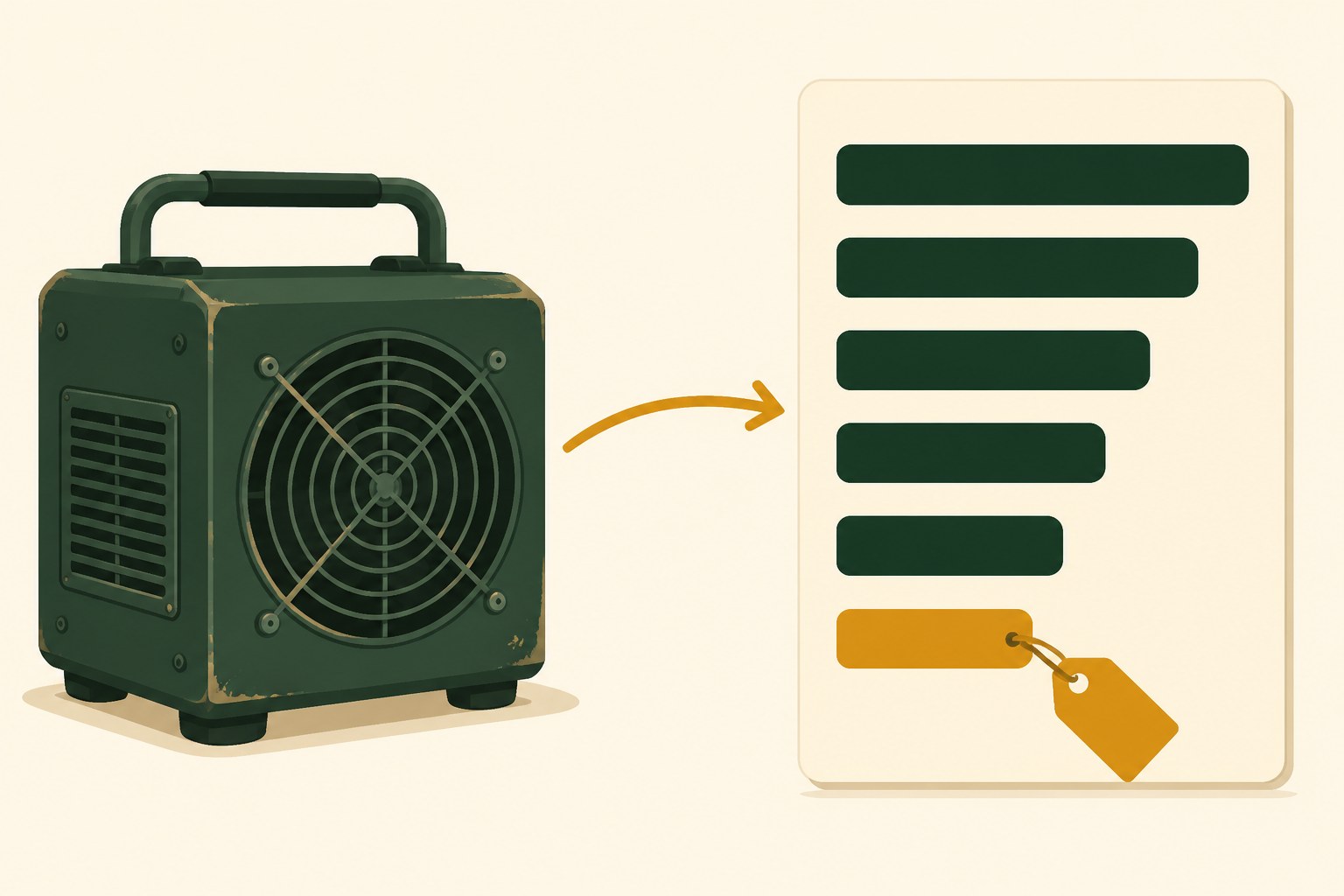
A single product photo used to be the start of twenty minutes of typing.
AI eBay listing software collapses that into seconds: you hand it a
photo or a product name, and it hands back a complete draft — an 80-character title,
the category, item specifics, a condition line, a description, and a price anchored to
real sold comps. You review it and publish. This guide shows exactly how that works,
where it quietly fails, and what the sold-comp data actually looks like underneath —
using numbers pulled from our own 864,000-row sold-listing database, not vendor
marketing.
What AI eBay listing software actually is
It’s a tool that uses a vision-capable language model to turn minimal input — a photo,
a product name, a supplier URL, a spreadsheet row — into a structured, ready-to-publish
eBay listing. Instead of you filling every field, the model reads the item, identifies
it, and drafts the whole listing. Then it stops and waits for you.
That last part is the whole design. Good listing software doesn’t publish behind your
back; it gets you from a blank form to a 90%-finished draft in seconds and puts you in
front of it. The pitch isn’t “AI replaces the seller.” It’s “AI does the typing, the
seller keeps the judgment.”
Which means it pays off in direct proportion to how varied your inventory is.
If you list the same UPC a thousand times, eBay’s own catalogue and a saved template
already solve your problem. If you list a thousand different things — pallet
buys, estate lots, refurbished gear, decommissioned equipment — every single item is a
fresh twenty minutes, and that’s the problem worth automating.
How it works: photo in, listing out
Four stages. Knowing them tells you which parts to trust and which to check.
1. Vision — the model reads the photo
A vision model examines the image and pulls out what it can literally see: object type,
brand marks, model plates, connectors, labels, visible wear, and any text printed on the
item or its case. On an ASIC miner it reads the model plate and the hashrate sticker. On
a laptop it reads the badge, the port layout, and the screen condition. On an industrial
part it reads the OEM number stamped into the casing — which is usually the only thing
that identifies it at all. Which photo you take matters more than which camera you use:
see what a vision model can and can’t read off one
photo.
2. Identification — resolving that into a real product
Those observations get resolved into a concrete identity: brand, model, MPN, category.
This is the step that separates “black laptop” from “Dell Latitude 7420, i7-1185G7,
16 GB.” It is also the single biggest quality difference between listing tools, and the
one you can test in about four minutes by throwing three awkward items at a free trial.
3. Generation — writing the fields
With an identity in hand, the model writes to eBay’s conventions: keyword-ordered title
inside 80 characters, item specifics mapped to the category’s expected fields, a
description that front-loads what buyers actually search, and a condition line. The
constraint that matters here is negative: the model must be held to what the photo and
your inputs support, and must leave a field blank rather than invent a
plausible value.
4. Pricing — and this is where most tools quietly fail
Price is the field with real money attached, and it’s the field most likely to be
hand-waved. The next section is what the underlying data actually looks like.
What “priced from real sold comps” has to mean
Every listing tool claims it prices from sold comps. Almost none of them tell you what
happens when you actually run the query. Here is a real one.
We keep a local database of sold eBay listings — 864,000 rows at the time of writing,
collected through mid-July 2026. Search it for antminer s19 and you get
1,743 matches. Take a 500-row sample and compute the obvious number:
| How you filter | Rows | Median | Mean |
|---|---|---|---|
| Raw keyword match, no filtering | 500 | $69.00 | $418.01 |
| Title must contain both “Antminer” and “S19” | 210 | $104.99 | $189.12 |
| …parts, hashboards, control boards, PSUs removed | 89 | $290.00 | $323.26 |
The naive answer is $69. The defensible answer for a complete, working
unit is $290. That is a 4.2× error, and it is the difference between
breaking even and giving inventory away.
Two separate things are going wrong in that first row, and they fail differently.
Keyword collision. Twenty-two of the 500 rows never say “Antminer” in the
title at all. Eleven of those are still real S19 hardware — bare hashboards, AMLogic C83
control boards, an APW12 PSU — and the parts filter below catches them. The other eleven
are not S19s in any sense. They matched because the string “S19” happens to appear in the
title: four Garvee SAC18-2-S19 mini-split air conditioners ($316–$450), YYK-S19 Bluetooth
earbuds at $15, a Deebot X2 robot-vacuum battery (part number S19-LI-144-6400), a MERACH
S19 recumbent exercise bike at $379.99, a Limink S19 laptop screen extender, an Asus
Chromebox whose title simply ends “(S19)”, and — genuinely — a pair of Vans SK8 skate
shoes. Two percent of the sample, $15 to $450, quietly dragging the distribution around.
And the expensive end of that raw sample contains no S19 either. Sort the
500 rows by price and the ten dearest — $3,520 to $9,597 — are every one of them a
different machine: a ten-unit lot of Antminer S21s at $9,597, two more S21 lots at $5,600
and $4,997, and seven Antminer Z15 Zcash miners between $3,520 and $7,000. They matched on
“Antminer”, not on “S19”. That is what a $418 mean sitting on a $69 median is actually
made of — and at the other end of the same sample, a lot of Antminer S1 boards sold for
parts at one cent.
Parts contamination, which is much worse. Of the 210 rows that really
are Antminer S19 listings, 121 are not miners. They’re single hashboards, control
boards, replacement PSUs, fans, and parts-only shells — median $45.00.
The 89 whole units sit at a median of $290.00. Blend them and you get a
number that describes nothing that exists.
And the model designation matters as much as the condition. Inside those 89 whole units:
- S19 XP (141 TH/s) — 37 sales, median $356.00
- S19j / S19j Pro — 19 sales, median $129.99
A tool that treats “S19” as one product is off by nearly 3× depending on which box is
actually on your bench — the full breakdown of that market is in our guide to
selling bitcoin miners on eBay.
So when you’re judging AI listing software, the pricing question
isn’t “does it use sold comps.” It’s: does it exclude parts listings, does it
separate model variants, does it report a median rather than a mean, and does it tell
you how many comps it found? A recommendation built on 89 filtered sales is worth
something. One built on 500 unfiltered keyword hits is worse than no recommendation,
because it looks authoritative.
This is also the honest case for Terapeak: it’s built into eBay Seller
Hub, it uses eBay’s own transaction data rather than scraped listings, and its category
and condition filters are good. If you sell in tidy catalogued categories, Terapeak is
the right default and you should use it. The gap it leaves is depth on the long tail —
industrial parts, mining hardware, odd enterprise gear, where the sample is thin and the
titles are a mess. That’s where a local sold-history database you can query and filter
yourself earns its keep — we compared the options in full in
Terapeak alternatives for product research,
including four live queries showing how far a keyword-matched average drifts.
What a complete draft actually contains
- Title — keyword-ordered, ≤80 characters, brand + model + the one spec buyers filter on.
- Category — the leaf category, which determines which item specifics eBay demands.
- Item specifics — brand, model, MPN, plus category-required fields.
- Condition + condition description — a grade plus honest notes (“tested, rack wear, one missing screw”).
- Description — scannable and mobile-first, because most of your traffic is a phone.
- Identifiers — UPC/EAN/MPN where legible, which unlock eBay’s catalogue.
- Suggested price — with the comp count and spread behind it, not a bare number.
- Photos — ordered, primary chosen, optionally background-cleaned.
A worked example, field by field
A used ASIC miner, photographed with its model plate. Here’s manual entry versus what
comes back. The price column is the real figure from the comp analysis above.
| Field | Manual | Generated draft |
|---|---|---|
| Title | blank — you compose it | Bitmain Antminer S19 XP 141TH/s SHA-256 Bitcoin ASIC Miner 3010W Tested (69/80) |
| Category | hunt the tree | Computers/Tablets & Networking > Crypto Mining Hardware |
| Brand / Model | type both | Bitmain / Antminer S19 XP |
| Condition | choose + describe | Used — grade suggested from visible wear, left for you to confirm |
| Key specifics | hashrate, algorithm, power, cooling | 141 TH/s · SHA-256 · 3010 W · air-cooled |
| Price | guess, or an hour of research | $356 — median of 37 whole-unit S19 XP sales; parts listings excluded |
Your job shrinks to verification: confirm it actually hashes at the rated figure, check
the price against your cost basis, correct the condition wording to match the unit in
front of you, publish. If you want to see the shortest version of this path — type a
product name, get a titled and categorised listing back — that’s what
AI Quick-Fill does.
The time math
Concrete rather than hand-wavy. A careful manual listing of a varied item takes an
experienced seller roughly 12–18 minutes once the photos are taken — title, category
hunt, specifics, price research, description. Call it 15. With generation plus a real
review, it’s about 3–5 minutes, nearly all of it review. Call it 4.
| Listings / week | Manual @ 15 min | AI + review @ 4 min | Hours back |
|---|---|---|---|
| 25 | 6.3 | 1.7 | 4.6 |
| 50 | 12.5 | 3.3 | 9.2 |
| 100 | 25.0 | 6.7 | 18.3 |
Those are estimates from our own listing sessions, not a study — treat them as the shape
of the saving, not a promise. The second-order effect is the bigger one anyway: at four
minutes a listing, items that weren’t worth fifteen minutes suddenly are. Whole
categories of $30–$60 inventory stop being a waste of an evening.
Rewriting the listings you already have live
Everything above is about listings that don’t exist yet. The other half of the job is the
ones that do. Our own eBay account carries 88 live listings, most written
months ago, several written badly, and revising them by hand is the chore nobody gets
round to — which is exactly why it’s worth handing to a model.
The design constraint is stricter here than for a fresh draft. Anything that can rewrite a
whole account can also wreck one in a single click, so reading and writing are separate
operations. The scan reads every live listing and reports what’s wrong across all of them
at once; it renames nothing and revises nothing, because a bulk edit that fired on
page load would be indistinguishable from an accident. The rewrite is the only action that
writes, and what it writes are drafts. It takes an explicit list of
listing IDs, so there is no “improve everything” instruction it can even be given.
What a rewrite actually changes
Title, subtitle, the full HTML description and the item specifics — judged as one listing
rather than field by field. Run end to end against a real live listing, the title moved:
| Title | |
|---|---|
| Before | Antminer S19 95TH/s Bitcoin Miner | Low Power 2800W Tune | VNiSH Firmware |
| After | Bitmain Antminer S19 95TH/s Bitcoin ASIC Miner VNiSH Firmware 2800W Tuned |
Same machine, same price, and — this is the part worth sitting with — both titles
are exactly 73 characters. The second one just spends them better: it carries
Bitmain and ASIC, two words buyers filter and search on
that the original never mentions, and it stops paying for two pipe characters and the word
“Low”. Alongside it the same pass produced 6.6 KB of HTML description, 11 spec rows and 17
item specifics filled.
Two things only showed up because this ran against a real account rather than a demo.
eBay’s own draft endpoint (sell/listing/v1_beta/item_draft) is a Limited
Release: on an account that was never approved for it, it answers 404 with an empty
body — so drafts have to land somewhere you control, or a whole sweep of paid-for
rewrites evaporates into someone else’s gated API. And “has this actually changed?” has to
be judged across the entire listing, because the item whose title is already fine is
usually the one whose description is worst.
The number worth remembering: 35 proposals, 2 real ones
Point any bulk auditor at a live store and it will find things. The first pass over those
88 listings proposed 35 changes. Checked against the actual account, 33 of
them were the tool being wrong:
- Normalising case before title-casing turned “UPS Ground” into “Ups Ground”, “SurePost” into “Surepost”, “PayPal123” into “Paypal123”. Words that already mix cases were capitalised on purpose.
- Reading trailing digits as a duplicate-copy index split the price off the end of a shipping policy: “+ Intl $329.99” became “$329. 99”, and “$350” became “$ 350”.
- eBay’s bulk listing call doesn’t return the category at all. Reporting that absence as “no category” invented a fault on all 88 listings at once — not-fetched and missing are different things, and a tool that conflates them will confidently tell you your entire store is broken.
Corrected, the plan came out at two proposals, and both were real. Treat
that ratio as the honest shape of bulk listing tools in general: the useful output isn’t
the long list on the first run, it’s the short one you get after the thing has been taught
the difference between a fault and a field it failed to fetch. If a tool audits your
account and hands you 40 urgent fixes, assume most of them are its problem, not yours.
Write the description for the phone
A large share of eBay traffic is the mobile app, and the app strips much of the CSS that
flex and grid layouts depend on. Descriptions built on tables with inline styles survive
that; descriptions built on a modern stylesheet collapse into an undifferentiated column.
Worth knowing too: a “maximum 4,000 characters” instruction can’t hold a table layout, and
all it really achieves is teaching the model that the instructions are optional. Better to
refuse a description that comes back as plain text than to draft it and leave yourself
eighty walls of unformatted text to review.
When not to do this. Don’t bulk-rewrite a listing that is already selling.
Performance is evidence; an audit score is an opinion. It’s the same trap that makes
automated price cuts dangerous — on this same account, one 138-day listing sat 38% “above
market” and had nonetheless sold 44 units and collected 64 watchers, and the discount
ladder still wanted $8,400 of margin off it. We worked that one through in full in
eBay repricing software. And if you have five
listings, eBay’s own Revise Item is free and takes two minutes. This earns its keep at
dozens, where the alternative is that the rewrite never happens at all.
Where it breaks, and what to check every time
It cannot know whether something works
A photo shows cosmetic condition. It cannot show that a unit powers on, holds a charge,
or hashes at its rated speed. You assert “tested and working” — never
let a tool assert it for you. That’s an accuracy problem and an eBay policy problem at
the same time, and it’s the one that generates returns.
It can invent specs on unfamiliar items
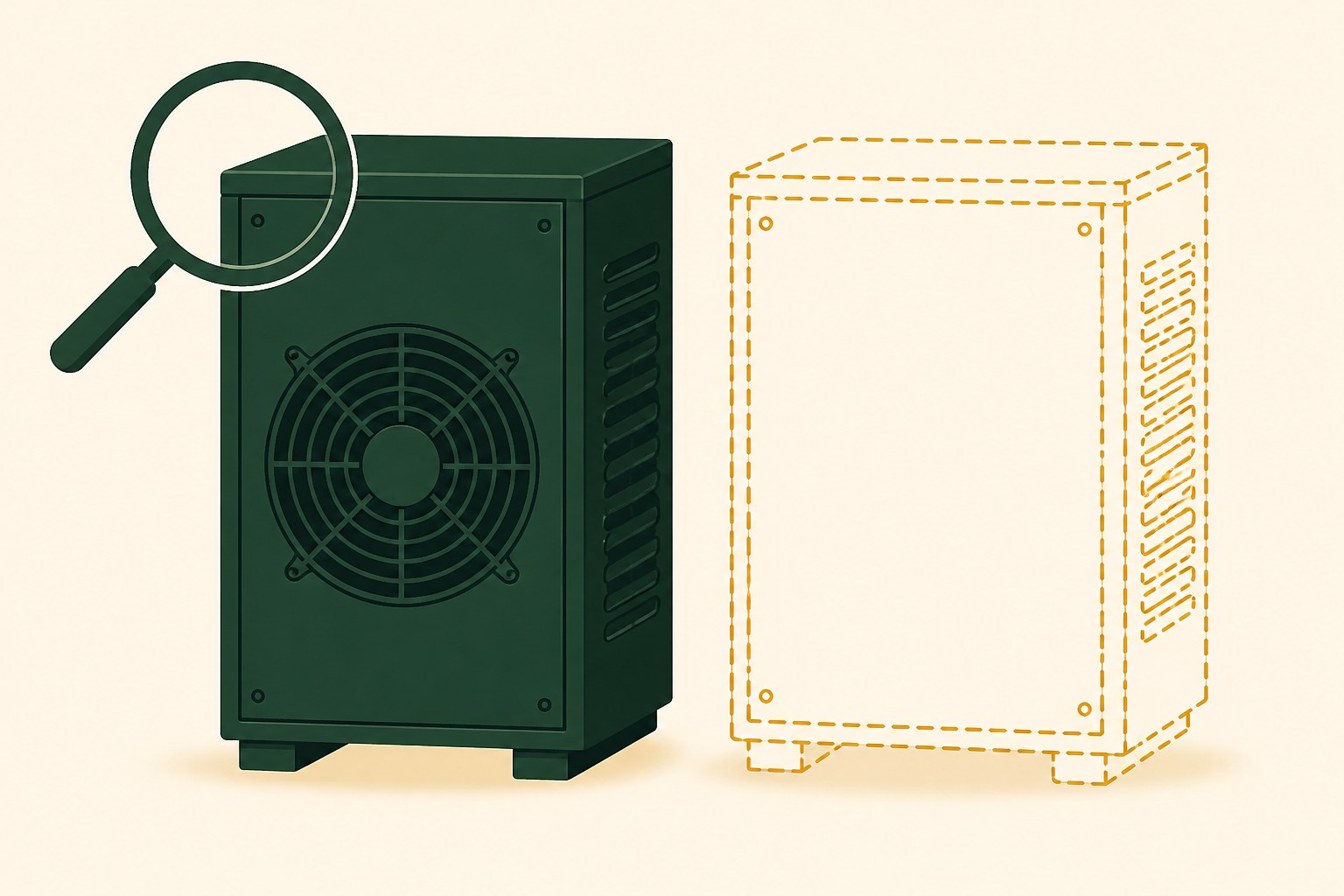
Given a rare or ambiguous item, a weak tool fills gaps with plausible-sounding values.
Blank is better than wrong. Verify model numbers and technical specs against the actual
item, especially anything over about $200 where a wrong spec turns into a not-as-described
case.
Category choice is quietly high-stakes
Category drives both which specifics eBay requires and whether buyers filtering by
category ever see you. It’s usually right, and a two-second glance catches the times it
isn’t. Skipping that glance is how listings end up invisible.
The price is the market’s number, not yours
A comp-based recommendation says what the market has paid. It doesn’t know what you paid.
Treat it as the ceiling and apply your own floor.
None of this argues against AI listing — it argues for keeping the review step. Handled
that way, AI-assisted listings sit comfortably inside eBay’s rules, because eBay’s
policies govern what a listing says, not which tool typed it, and a human is
still signing off on every word.
How to choose — and when a competitor is the better answer
Judge candidates on the things that change outcomes:
- Identification accuracy on your inventory. Test it with three awkward items, not the demo item.
- Pricing methodology. Does it show comp count, median, and spread — and does it exclude parts listings? Ask this specifically.
- Review-first design. Every field visible and editable before anything reaches eBay.
- Official API publishing, not copy-paste or browser automation.
- Where your data and keys live, and whether they’re encrypted at rest.
Being straight about it, here’s where other tools genuinely beat a single-marketplace AI lister:
-
Vendoo and List Perfectly are better if your real problem is
cross-posting the same inventory to Poshmark, Mercari, Depop, Etsy and eBay and keeping
quantities in sync. Breadth across marketplaces is what they’re built for, and an
eBay-focused tool won’t match it. -
Terapeak is better for authoritative eBay sold data in mainstream
catalogued categories — it’s eBay’s own data, Product Research is free with any seller
account (only Sourcing Insights needs a Basic Store or above), and its filters are solid. -
eBay File Exchange is better if you already have clean, structured
catalogue data and just need to push thousands of rows. It’s free and it’s a firehose.
It’s also miserable for one-of-a-kind used goods, which is precisely the gap AI listing
fills.
The case for an AI listing tool is narrower and, we’d argue, deeper: varied, unbranded,
or technical inventory where the bottleneck is describing the item at all —
and where the sold-comp data is messy enough that filtering it properly is the whole job.
If that’s not your bottleneck, use one of the above instead.
Getting started
- Connect your eBay account so drafts publish through the official API. The dashboard then reads your real inventory — how the connected store view works.
- Add an AI key. You supply your own, so you pay the model provider directly rather than a per-listing markup.
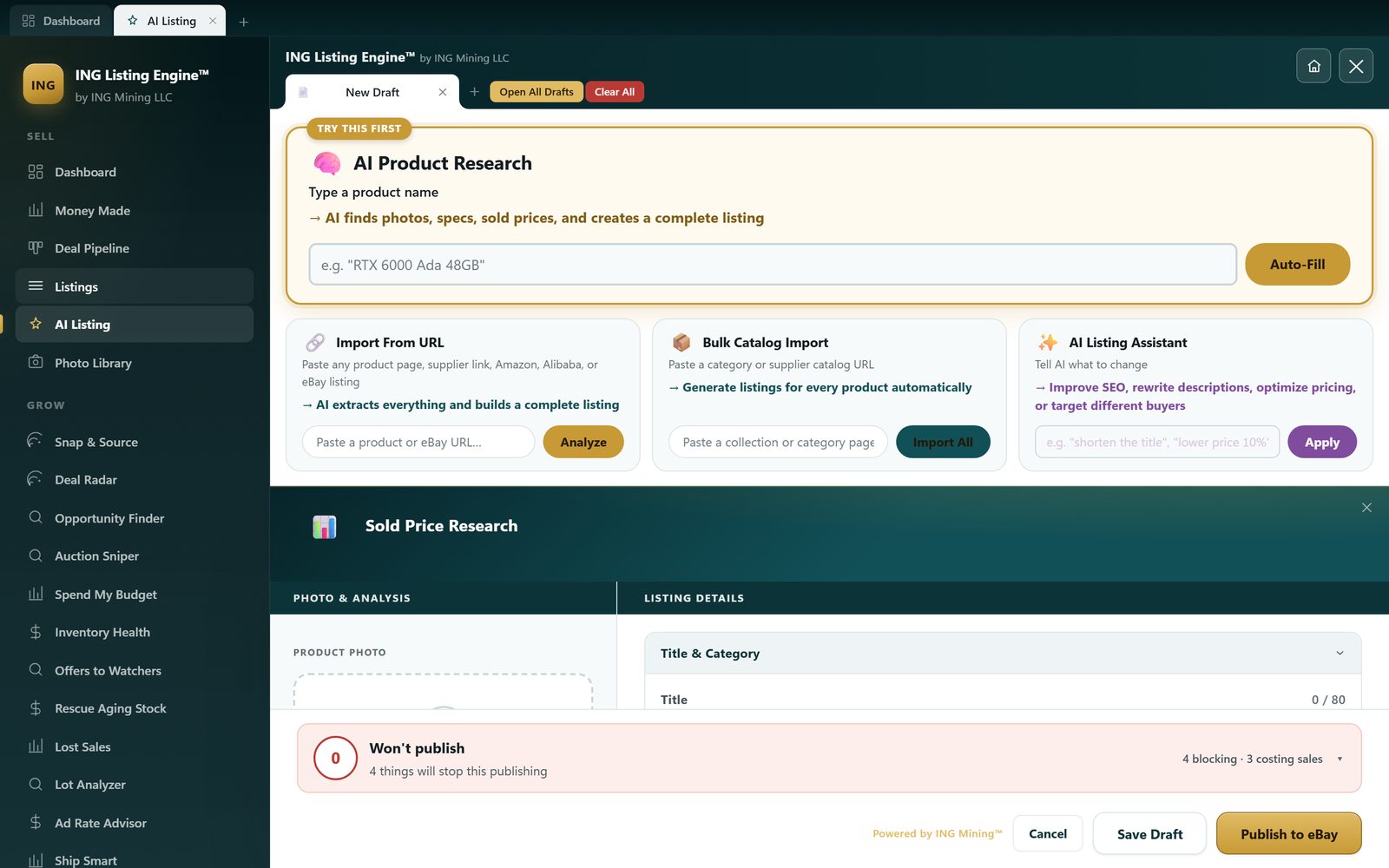
- Drop in a photo, or type a product name, and let it draft.
- Review every field. Condition, specs, category, price floor.
- Publish, then look at what to list next — the Opportunity Finder ranks candidates by sell-through and estimated profit.
Try it on your next listing. The ING Listing Engine turns a photo or a
product name into a complete, comp-priced eBay draft you review and publish. It’s free
during the public beta, for Windows, with no paywall —
download the ING
Listing Engine, or read more about it on the
ING Listing Engine home page.
Common questions
Is using AI to write eBay listings against eBay’s rules?
No. eBay’s policies govern what a listing says — accuracy, condition honesty, prohibited
content — not the tool used to write it. Because you review and approve every draft
before it publishes, you remain responsible for its accuracy, which is exactly what eBay
requires. The risk isn’t “AI wrote it,” it’s “nobody checked it.”
How accurate is identification from a photo?
Strong on items with a visible brand, model plate, or part number. Weak on unmarked or
ambiguous items, where a good tool should leave fields blank instead of guessing. Test it
on your own hardest items before you trust it on volume.
Does it set the price for me?
It recommends one from comparable sold listings, anchored to the median with parts and
mismatched models filtered out — as in the S19 example above, where correct filtering
moved the answer from $69 to $290. It can’t know your cost basis, so the floor is yours.
Do I still have to review every listing?
Yes, and it’s about two minutes. Condition claims and technical specs are where the money
and the policy risk both sit.
Can it fix listings I’ve already published?
Yes. It reads every live listing, reports what’s wrong across the whole account, and rewrites title, description and item specifics as drafts you publish yourself — scanning on its own never changes anything. Expect the first audit to overstate the problem: on our own 88-listing account it proposed 35 changes and only 2 survived checking.
What does it cost?
Pricing models vary across the market — per listing, per month, or bring-your-own-key.
The ING Listing Engine is free during the public beta; you supply your own AI key and pay
the model provider directly for usage.
Deep dives in this topic
- AI eBay listing from a photo: what it reads and what it can’t — the six fields a photo can never tell you, and how to shoot the spec plate so identification works.
- AI Quick-Fill: type a product name, get a complete listing
- Opportunity Finder: what’s worth listing next
- Working from a real, connected eBay store
- Terapeak alternatives for product research — why keyword-matched sold averages are usually wrong, tested on 864,000 rows.
- eBay repricing software — pricing the listings you already have live, against the same comp data.