
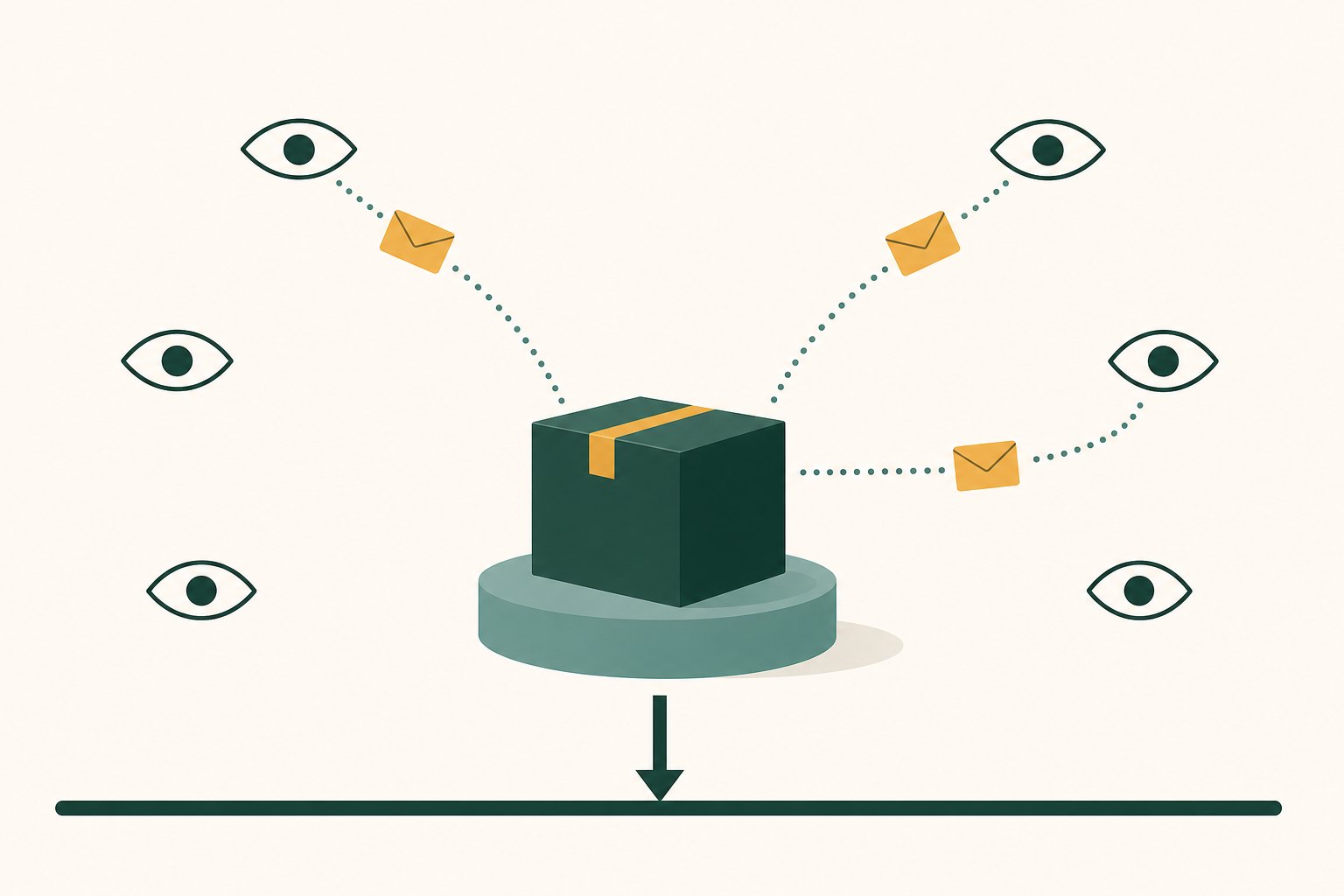
Send offers to watchers and you’re using the only discount on eBay that costs nothing when it’s refused. The public price never moves. Only people who already hesitated ever see it. If nobody accepts, you’re out a couple of minutes and no margin at all. That’s what makes the button easy to press — and why almost everyone presses it badly, blasting eBay’s 5% minimum at everything eligible and handing money to buyers who were going to buy anyway.
The button isn’t the problem. The number in the box is. Below: what eBay actually does when you send, how deep the discount should go, and the floor arithmetic that decides whether a 20% offer is a sale or a quiet loss.
What eBay actually does when you send offers to watchers
Worth getting the mechanics right first, because a lot of what’s written about this is wrong.
- It goes to the 30 most recent interested buyers — people watching the item and people who’ve had it in their cart for at least two days. If you have more than 30, eBay sends the first 30 and keeps going in batches of 30 every 48 hours until everyone’s had one (eBay’s own help page).
- The “10 watchers” figure you’ll see repeated is wrong. It comes from the Negotiation API’s Sandbox documentation, where a test call returns a maximum of 10 mock offers. That’s a test-environment cap, not a selling rule.
- On eBay.com an offer runs 96 hours, not 48. Most other eBay sites are 48. This one has a genuine trap in it: the API documents the offer duration as fixed at two days and reports two days back to you, while the offer the buyer actually sees runs four. There’s a developer report of exactly that discrepancy sitting unanswered on eBay’s forums. Our own app’s footnote says “about 48 hours” because that’s what the API states — on eBay.com you get longer.
- Eligibility is eBay’s call, not yours. Listing age, listing format, and rules that cap how many offers a single buyer can receive all feed into it. You can’t argue with it and you can’t see the whole rule.
- The minimum is 5% off, and once an offer is sent you can’t take it back.
- Your public price never moves. Search results keep showing the original Buy It Now price whether or not someone accepted a discount.
That last point is the whole economic argument. A markdown gives margin to everyone, including the buyer who’d have paid full price this afternoon, and it keeps doing that for as long as the sale runs. An offer gives it only to people who already looked and didn’t buy.
All of which assumes people are looking in the first place. A listing with no watchers at all has nobody to send an offer to, and that is a visibility problem rather than a price one — a different checklist, starting with whether the listing is even indexed.
What the watcher pile actually looks like
Real numbers, from the first live scan against our own eBay account rather than a demo one. 87 active listings. 53 of them had at least one watcher, and those 53 listings carried 1,527 watchers between them. eBay confirmed 31 could carry an offer right then, reaching 1,362 of those watchers in a single click. The other 21 came back not eligible — mostly multi-unit lots and listings still inside eBay’s repeat-offer cooldown.
Fifteen hundred people had raised their hand and were converting into nothing. That’s why this runs off the same scan as repricing the stock that’s already live — repricing asks what an item is worth to the market, offers ask what it’s worth to the people already looking at it.
Here’s the part a marketing page is tempted to lie about. Seventeen offers on that run represented $22,619 of gross revenue if one offer per listing is accepted, against $2,501 of margin given away if every single one is accepted. Both figures are per listing, not per watcher. A listing with 688 watchers does not sell 688 units because an offer went out, and any tool that multiplies discount by watcher count is producing a beautiful number with nothing behind it.
How deep the discount should go
Start at eBay’s 5% floor and build from there. Every input below either adds or takes away percentage points:
| Signal | Effect on the offer | Why |
|---|---|---|
| Listing age | +3 / +5 / +8 points at 30 / 90 / 180 days | The longer it’s sat, the likelier the price is the blocker |
| 10+ watchers | −2 points | A crowd is evidence the item is wanted; it takes less to close |
| 5+ watchers | −1 point | Same reasoning, weaker signal |
| 1–2 watchers | +2 points | One watcher is a maybe, not demand |
| Priced above market | Deep enough to reach the going rate | A discount to a price that was never competitive closes nothing — watchers can see the same comps you can |
| Already under market | Capped at 8% | The hesitation isn’t about price. Don’t pay for it |
| No cost basis recorded | Capped at 10% | Without a floor there’s no way to know a 20% offer isn’t a 20% loss |
| All of it at once | Hard cap 25% | Past a quarter off, that’s a repricing decision a human should look at, not a default |
The watcher rows are the counter-intuitive ones. Instinct says a big audience deserves a bigger push; it’s the opposite, because a big audience is proof the listing is already attractive and the offer only has to nudge.
The floor, and the arithmetic nearly everyone gets wrong
Say you want to keep at least $25 on every sale. The mistake is raising your floor by $25.
eBay’s cut scales with the sale price, so buying back $25 of profit costs more than $25. The floor has to go up by $25 ÷ (1 − fee fraction). At a 13% final value fee that’s about $28.74, not $25. Get it wrong and every offer you send “at my floor” lands under it by a few dollars, every time, invisibly.
Three floors, and the offer price is never below the highest of them:
- Break-even — what the item has to clear after every fee, using the same fee model that costs an item on every other screen.
- Break-even plus your minimum profit, grossed up as above.
- The quick-sale price — what the comps say the item moves at with no offer at all. Discounting below that is paying for a sale the listing was already getting.
And a fourth rule that isn’t a floor: a failed comp match can’t move anything. The first live run showed why — multi-unit lots matching against stray $35 accessories, the same keyword-matching failure we took apart at length in our look at sold-comp research. Rows with no trustworthy market price show no market price and get no market-driven discount.
When even the 5% minimum would land under the floor, the row reads “Under my floor” and names the number. It doesn’t quietly suggest a smaller offer that still loses money.
What the screen looks like
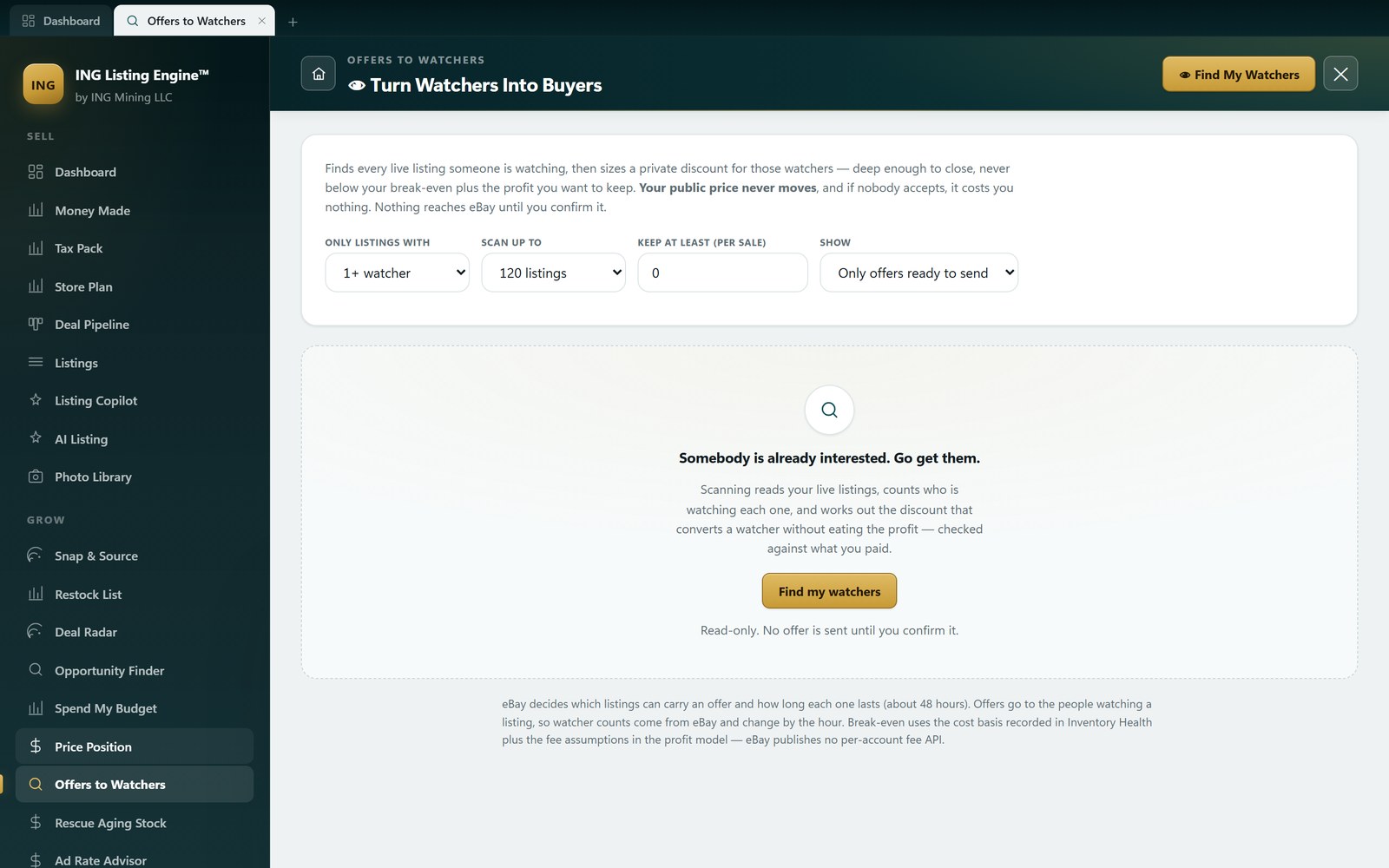
The note along the bottom is deliberate. Break-even is built from the cost basis you recorded plus assumed fees, because eBay publishes no per-account fee API — your real rate depends on store level, category and seller standing. Any tool quoting your exact fees to the cent is guessing at one of those three.
What it won’t do
Three brakes stand between the board and a buyer’s inbox, and they’re the same three the repricer uses because this is the only other thing in the app a buyer can see:
- Preview by default. Nothing sends unless the request explicitly says so and carries a separate confirmation. Verified live: a request with sending switched on but confirmation off came back as a preview with nothing sent.
- The floor is recomputed server-side from the stored cost basis, never trusted from the browser. Also verified live: a $189 offer on a $180-cost item was refused against its $207.95 break-even, and a $315 offer was refused against a $323.22 minimum-profit floor. There’s an override for deliberately clearing stock at a loss, and using it writes a line to the action log.
- eBay’s eligibility answer is asked first, once per scan, so ineligible listings are shown as ineligible rather than failing at send time.
Sending needs the sell.negotiation permission, requested at login. Connect your store before this shipped and everything else keeps working — the board still builds off watcher counts and just asks you to reconnect before it can send.
The honest limit: we have never fired a real send. Every layer underneath it has been exercised end to end — the request, the server-side floor re-check, the 5–25% range check, the preview path, the confirmation gate. The final call puts a real, non-recallable offer in front of real buyers on a real account, and that’s a click for the account’s owner, not for an automated test session. The send path is verified up to but not including the send, and we’d rather write that than imply otherwise.
When eBay’s own tools are the better answer
Three cases where you should not install anything:
- You just want 5% at everything eligible. Seller Hub does this free and faster than any download. Filter Active Listings by “Send offers – eligible”, select all, send. If your margins are wide and roughly uniform, that is the correct move and a ladder is over-thinking it.
- You want a visible sale. Markdown Manager is free and puts a strike-through price on the listing itself. An offer can’t do that — the public price doesn’t move, which is exactly the point, right up until visibility is what you wanted.
- You sell catalogued goods at thin, uniform margins. If every unit of your SKU cost the same, a flat percentage is fine and this is over-engineering. We built it for used ASIC miners, servers and industrial gear, where two units of the same model can have cost $180 and $600.
It earns its place in the case between those: enough listings that reading them one at a time is a lost afternoon, and enough variation in what you paid that a single flat percentage would be generous on half of them and a loss on the rest. Same reason the maximum-bid ceiling exists on the buying side — the arithmetic isn’t hard, it’s just wrong to do in your head forty times.
Offers to Watchers ships inside ING Listing Engine, a Windows desktop app, alongside the repricer it shares a scan with. It’s a free open beta you can point at your own store — no paywall, and the scan is read-only until you confirm something. If you sell what we sell, the guide to selling bitcoin miners on eBay covers where the comp data behind these floors is strongest, and where it isn’t.
Common questions
How many watchers does eBay send an offer to? The 30 most recent interested buyers — people watching the item and people who have had it in their cart for at least two days. If a listing has more than 30, eBay sends the first 30 and continues in batches of 30 every 48 hours until everyone has received one. The figure of 10 that circulates online comes from the Negotiation API’s Sandbox documentation, where a test call returns a maximum of 10 mock offers; it is a test-environment cap, not a selling rule.
How long does an eBay offer to watchers last? On eBay.com and eBay.co.uk an offer is valid for 96 hours, or until the listing sells, whichever comes first. Most other eBay sites use 48 hours. Note that the Negotiation API documents the offer duration as fixed at two days and reports two days back to the caller, while the offer the buyer sees on eBay.com runs four.
What is the minimum discount on an eBay offer to buyers? 5% off the current Buy It Now price. An offer must also be lower than the listing’s posted price, and once sent it cannot be withdrawn.
Does sending an offer lower my listing’s public price? No. The offer is private to the buyers who receive it, and search results continue to show the original Buy It Now price whether or not anyone accepts. That is the main advantage over a markdown, which gives margin to every buyer including the ones who would have paid full price.
Why are some of my listings not eligible to send offers? eBay decides eligibility, based on the age and format of the listing and rules limiting how many offers a single buyer can receive. Multi-unit lots and listings still inside eBay’s repeat-offer cooldown are commonly refused. On a real scan of 87 active listings, eBay confirmed 31 could carry an offer and refused 21 that had watchers.
How much should I discount when sending an offer to watchers? Start at eBay’s 5% minimum and adjust for evidence. Older listings justify a deeper offer; a large watcher count justifies a smaller one, because a crowd is proof the listing is already attractive. Never go below the highest of three floors: break-even after fees, break-even plus the profit you insist on keeping, and the price the comps say the item sells at with no offer at all.
If I want to keep $25 profit, how much do I raise my floor by? By more than $25. eBay’s fee scales with the sale price, so buying back profit costs more than the profit itself. The floor rises by $25 divided by one minus the fee fraction — about $28.74 at a 13% final value fee. Raising it by a flat $25 puts every offer you send slightly under your own floor.
Filed under Pricing & Profit · Tagged Fees & margin, Offers & watchers, Automation · Browse all guides by topic