

A Basic Store starts paying for itself at 313 live listings. Below that, the free 250 listings every seller already gets are cheaper than any eBay Store subscription on the rate card. That is the whole decision for most people, and it is a listing-count question rather than a revenue question — which is why so many sellers get it wrong in both directions.
Two things almost nobody tells you. The Starter Store is never the cheapest plan at any listing count — not at 100 listings, not at 10,000 — and there is a second, quieter reason to subscribe that has nothing to do with insertion fees and can flip the answer for a high-volume seller. Both are below, with the arithmetic printed so you can check it rather than trust it.
The number that decides it is how many listings you keep live
This is the part people miss. A fixed-price listing renews every 30 days, and each renewal spends one of that month’s zero-insertion-fee listings. So the number eBay charges you on is not how many items you list this month — it is how many you keep live. A seller who lists nothing new but holds 900 items on Good ‘Til Cancelled is buying 900 listings a month.
Go and get your real number before you read the table: Seller Hub → Listings → Active. It is usually higher than people guess, because the slow-moving stock at the back is invisible until it turns up on an invoice.
Every tier, and the band it is actually cheapest over
Read off eBay’s own subscriptions-and-fees page on 10 August 2026. Prices are per month; the first column is the rate you pay when you commit to a year, which is what almost everyone should be comparing.
| Tier | Billed annually | Billed monthly | Free listings/mo | Each one after | Cheapest between |
|---|---|---|---|---|---|
| No store | free | free | 250 | $0.35 | 0 and 312 |
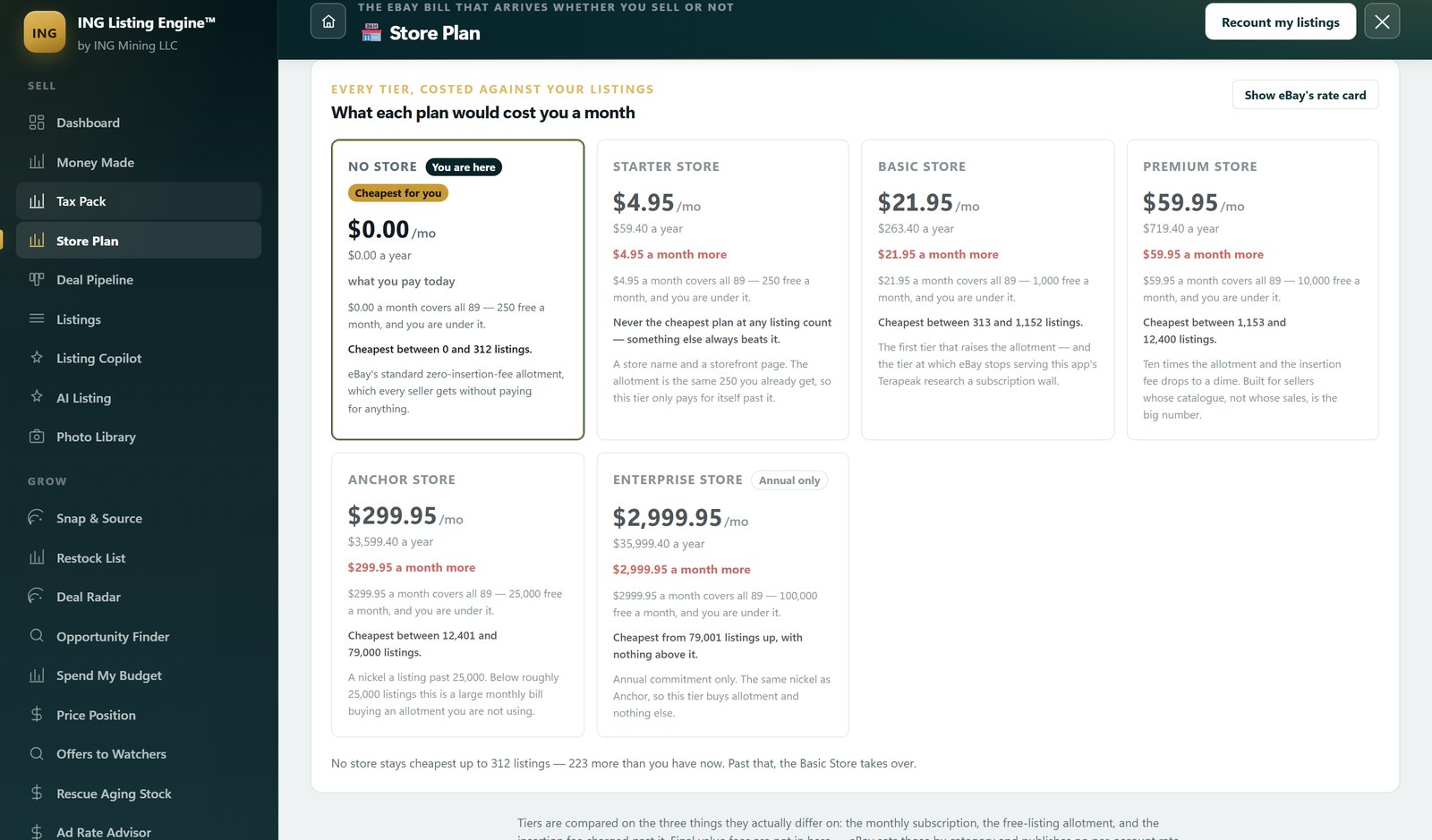
| Starter Store | $4.95 | $7.95 | 250 | $0.30 | never |
| Basic Store | $21.95 | $27.95 | 1,000 | $0.25 | 313 and 1,152 |
| Premium Store | $59.95 | $74.95 | 10,000 | $0.10 | 1,153 and 12,400 |
| Anchor Store | $299.95 | $349.95 | 25,000 | $0.05 | 12,401 and 79,000 |
| Enterprise Store | $2,999.95 | annual only | 100,000 | $0.05 | 79,001 up |
Every crossover in that last column is hand-checkable, and the first one is worth doing yourself. At 312 listings with no store you pay for 62 of them at $0.35 = $21.70, a nickel under the Basic Store’s $21.95. At 313 it is $22.05, and the store is cheaper from there on, forever. That is the entire “is an eBay Store subscription worth it” question in one line of arithmetic.
If you pay monthly rather than annually, every band shifts right — no store stays cheapest to 329, Basic runs to 1,188. Same shape, slightly later.
The Starter Store is never the cheapest plan, at any listing count
This is arithmetic, not an opinion, and it holds on both billing cycles. The Starter Store’s allotment is the same 250 free listings everybody already gets without paying anything. All $4.95 a month buys you on the fee side is a 5¢ discount on each listing past 250.
So Starter has to clear two hurdles at once. It only beats having no store at all once you are past 350 listings — that is where 5¢ a listing has repaid the $4.95. But the Basic Store, with its thousand-listing allotment, has already beaten Starter from 307 listings. The window where Starter wins would have to run from 350 up to 307, and that range runs backwards. There is no such listing count.
To be fair to it: Starter buys you a store name and a storefront page, and if you want those for $4.95 that is a perfectly reasonable thing to buy. Just do not buy it expecting it to reduce your bill. It is the tier sellers pick first because it is the cheapest number on the page, and it is the one tier that cannot be justified on fees.
The two expensive mistakes, and they run in opposite directions
900 listings and no store. You are paying 650 × $0.35 = $227.50 a month in insertion fees against a $21.95 Basic Store that covers a thousand. That is $2,466.60 a year for one click on eBay’s Subscriptions page. This is the common one, and it creeps up on people because the catalogue grows a few items at a time.
214 listings on a Basic Store bought years ago. You are paying $21.95 a month for an allotment the free 250 already covers — $263.40 a year for nothing. Nobody looks for this one, because nothing on eBay ever mentions that your catalogue has shrunk past the point where the store earns its keep. If you bought a store during a busy year and have since thinned the stock out, check.
There is also a free one with no trade-off attached: the same tier billed annually rather than monthly. Basic is $27.95 monthly and $21.95 annually — $72 a year for committing to a plan you were staying on anyway.
The thing our own tool leaves out, and it can flip the answer
Everything above compares tiers on three things: the subscription, the free-listing allotment, and the insertion fee past it. That is what the Store Plan screen in our app does, and it is deliberate — eBay sets final value fees by category and publishes no per-account rate, so folding a guess at them into the comparison would move the recommendation on a number you cannot audit. The Ad Rate Advisor hits the same wall on ad rates and answers it the same way: your own Seller Hub number beats our table.
It is also a real hole, and it points one way. On eBay’s own subscriptions-and-fees page, read the same day, the Store tiers from Basic upward are quoted a final value fee of 12.7% where a no-store or Starter seller is quoted 13.6%. That is roughly nine tenths of a percentage point off every sale, and it scales with revenue, not with listing count.
Run it: at a 0.9-point gap, a $21.95 Basic Store covers its own subscription at about $2,440 of sales a month — around $29,000 a year — no matter how few listings you keep live. A seller shifting that much through 150 listings is told by the insertion-fee arithmetic to stay on no store, and the insertion-fee arithmetic is answering the wrong question for them.
We are publishing that as a fault in our own product rather than burying it: the board’s recommendation is biased against subscribing, and the bias grows with your sales. It is on the fix list. In the meantime, if your monthly sales are into four figures, do the fee-discount sum before you take a “stay where you are” answer from us or from anyone else.
Two caveats on that 0.9 points, and they matter. eBay’s fee bands are not identical above the main threshold, and the rate is category-specific — ASIC miners, for instance, sit in Coins & Paper Money at their own rate, which is worked through in detail on our miner lots page rather than repeated here. Look up your own category’s number and put that in place of 0.9 before you decide.
What the app does with it
The Store Plan screen reads the number of active listings straight off your connected eBay account, costs all six tiers against it, and names the one you should be on. It is the only recurring charge in a reselling business that software can both see and fix, and acting on the answer costs nothing — you change no listing and take no risk.
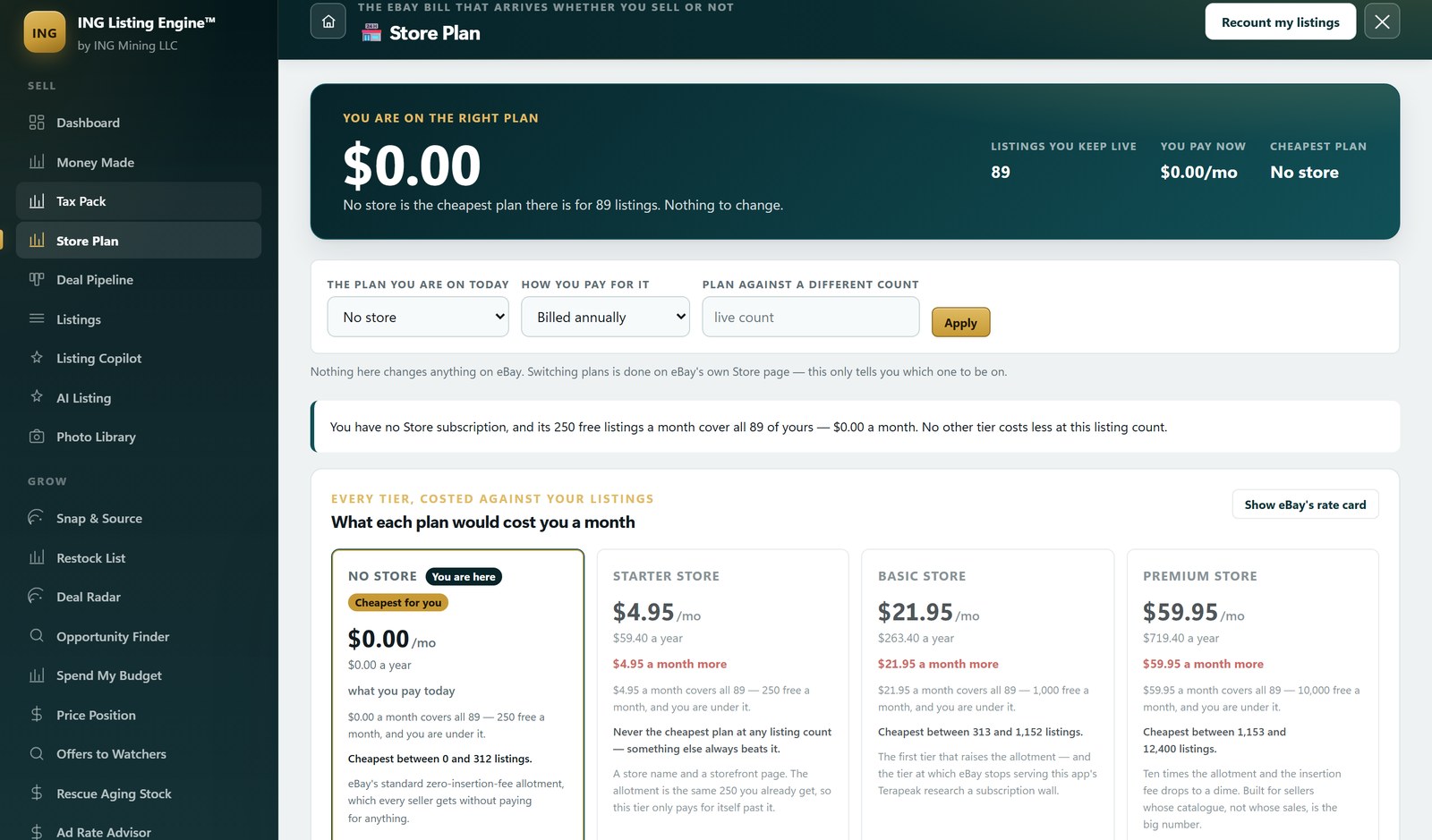
Two things about that screen are worth saying plainly. It changes nothing on eBay — there is no API for switching a subscription, and a screen that could quietly start a $299-a-month commitment should not exist. And it serves eBay’s published rate card in full, one click away, so every figure a recommendation was made from is checkable against eBay’s fee page in ten seconds. A rate card in software goes stale; one nobody can see goes stale invisibly.
Three things to check before you switch
Auctions have their own allotments and their own fees. Nothing above counts them. If a meaningful slice of your listings is auction-format, the comparison is a different one.
Churn pushes you up, never down. The count that matters is what is live at the moment you look, so if you also list and sell items inside the same month, your real chargeable count is higher than your active count — which makes the bigger tier worth more than the table says, never less.
The non-fee perks are yours to value. A storefront page, promotion tools and Terapeak’s Sourcing Insights are worth a lot to one seller and nothing to the next; the sold-comp research half of Seller Hub is free either way, and where Terapeak stops being enough is a separate question from what tier you pay for. Nobody can price those for you. Price the fees, then decide what the rest is worth on top.
If you would rather not do the arithmetic by hand every quarter, ING Listing Engine counts your live listings and runs this comparison for you on your own Windows machine, free during the beta. It is the same maths as the table above — you can also just do it with your active-listing count and a calculator, and the numbers on this page are the ones you would need. While you are looking at what your catalogue costs to hold, the money already sitting in stale live listings is usually the larger figure — and on the ones that have already collected watchers, a private offer moves stock without the public price ever changing.
Questions sellers actually ask
How many listings do you need for an eBay Store to be worth it?
313 live listings, on the current US rates with annual billing. Below that the free 250 plus $0.35 per extra listing is cheaper than the $21.95 Basic Store; above it the store wins and keeps winning. If you pay monthly, the crossover is 330.
Is the Starter Store worth $4.95 a month?
Not for the fees. Its allotment is the same 250 free listings you already get, so it is never the cheapest tier at any listing count — Basic overtakes it before it has finished overtaking having no store at all. Buy it if you want a store name and a storefront page, not to reduce your bill.
Do eBay Store subscribers pay lower final value fees?
Yes, from the Basic tier upward. On eBay’s own page in August 2026 the Store tiers are quoted 12.7% against 13.6% for a no-store or Starter seller — roughly 0.9 points. Rates are category-specific, so check yours, but at that gap a Basic Store covers its own cost at around $2,440 of monthly sales regardless of how many listings you keep live.
What happens to my listings if I cancel my eBay Store?
They stay live. You drop back to the standard 250 zero-insertion-fee listings a month and pay $0.35 for each one past that, so the risk of cancelling is a bill, not a takedown. Work out what that bill would be at your current active count first — that is exactly the 312-listing line above.
Should I pay for an eBay Store monthly or annually?
Annually, if you are staying on the tier anyway. Basic is $27.95 monthly against $21.95 annually — $72 a year for a commitment you were making regardless. The only reason to pay monthly is genuine uncertainty about whether you will still want the tier in six months.
Does an eBay Store give me more free listings?
Only from Basic upward. Starter’s 250 is the same 250 a seller with no subscription gets. Basic is 1,000, Premium 10,000, Anchor 25,000 and Enterprise 100,000 — and that allotment, not the storefront, is what you are actually buying.
Filed under Pricing & Profit · Tagged Fees & margin, Competitor comparisons · Browse all guides by topic