

Promoted Listings pays when the extra sales it buys are worth more than the fee charged on the sales you were already getting. That is the whole question. It is arithmetic, not opinion, and you can answer it for one listing in about a minute without spending anything first. Whether eBay Promoted Listings is worth it on your account turns on one number no advertising dashboard can look up: what you paid for the item.
Everything below is either quoted from eBay’s documentation with the date I read it, or arithmetic you can redo on a calculator. There are no campaign results here, because I do not have any, and that gap is stated plainly rather than filled with somebody else’s numbers.
What eBay actually charges you
There are two campaign strategies and they bill on completely different events. General is cost-per-sale: in eBay’s words, “you only pay when your item sells.” Priority is cost-per-click: “You’ll only pay when someone clicks on your ads.” Almost every argument about ad rates is about General, so that is the one costed below.
Four things about the General fee, in eBay’s own words:
- You pick a rate “between 2% – 100% of the item’s total sale amount”.
- Total sale amount means the whole thing. Since 1 June 2022 ad fees “are based on the total amount of the sale, which includes taxes, shipping costs and other applicable fees in addition to the final price of an item. It is the same value that is used to calculate final value fees.”
- The fee lands when “a buyer clicks on your promoted listing ad and purchases any of your promoted items within 30 days”.
- A click is not only a visit: “A click is when a buyer clicks through to your item page from your ad, or clicks the Add to Watchlist heart symbol on your ad.”
Two of those are worth reading twice. The purchase need not be the listing that was clicked — it is any of your promoted items, inside a 30-day window, and a tap on the watchlist heart counts as the click that starts it. A buyer who was always going to buy from you has plenty of ways to arrive looking like an ad-attributed sale.
Then there is the part eBay says out loud that almost every guide skips. eBay used to show sellers an estimated ad fee and withdrew the feature: “The Ad Fees estimation feature is now unavailable because the new ad rate calculation includes variables. Shipping costs depend on buyer location, so it is impossible to determine the total amount of the sale in advance.”
eBay cannot tell you what an ad will cost before the sale happens, and says so. What anyone can do is work out what a given rate costs on a given sale, and what it therefore has to buy back.
Sources, both read 15 August 2026: General campaign strategy and Changes to Promoted Listings Standard ad fees, eBay. Rates and rules change — check the date on anything you read about this, including this page.
The number that decides it: break-even lift
Three quantities, and only one of them is a guess.
- n — what one sale nets you today with no ads, after eBay’s cut, postage and packaging. This is the same figure that decides what you can afford to reprice to, and if you do not know it, stop here and work it out first. Everything else is built on it.
- f — the ad fee on one sale: your ad rate times the total sale amount, postage included.
- c — the share of your sales that would have happened anyway but get attributed to the ad and billed. This is the estimate.
You break even when the profit on the genuinely extra sales covers the fee charged on all the billed ones. Solve that and the lift you need is:
break-even lift = c × f / (n − f)
That is the extra sales, as a percentage of what the listing does today, the rate has to actually deliver before you are any better off.
Put numbers in it. A listing sells at $200 with $20 postage, so eBay’s total sale amount is $220, and after fees, postage and packaging it nets you $40. You set a 6% ad rate.
- Ad fee on a sale: 6% of $220 = $13.20.
- Profit on an ad-attributed sale: $40 − $13.20 = $26.80.
- Assume half the sales would have come anyway, so c = 0.5. Break-even lift = 0.5 × 13.20 / 26.80 = 24.6%.
A 6% ad rate on that listing has to lift its sales by about a quarter just to leave you level. Not to make money — to break even. If your honest expectation is a 10% lift, the answer is no, and you did not need a case study to get there. Those inputs are illustrative; put your own in, and the arithmetic will not care whose they are.
There is a second number, and it is a hard ceiling rather than a judgement call: the rate at which the ad fee equals the entire profit is n divided by the total sale amount, here $40 ÷ $220 = 18.2%. Above that, every ad-attributed sale loses money no matter how many of them there are. eBay will let you set 100%.
Why eBay’s suggested rate cannot answer this for you
eBay publishes a suggested rate, and a dynamic option that tracks it daily. It is worth looking at. It is just not answering your question, and eBay’s own description of it shows why. Suggested rates, per the same page: they “are calculated based on a variety of factors that may include item attributes, seasonality, past performance, and current competition in order to find an optimal balance between performance and cost.”
Read the list of inputs again. What you paid for the item is not in it, and it could not be, because eBay has never seen your invoice. A suggested 12% is a statement about what your competitors are bidding, not about whether your margin survives it. That is not a complaint — a marketplace-wide suggestion is the only kind eBay is in a position to make.
But it means the competitive floor and your margin ceiling are separate numbers, and a workable rate has to clear one while staying under the other. Where the field runs 11%, a 2% rate buys close to nothing; in a 4.5% category, 2% is a real bid. Same rate, opposite meaning — which is why “just use the suggested rate” and “never pay more than X%” are both bad advice.
Why can’t I promote my eBay listing?
This is one of the most common searches on the whole topic, and it usually has a dull answer. eBay’s stated requirement: “Above Standard or Top Rated sellers with enough account activity can promote fixed price listings for most categories.” Unpacked, that is four ways to be excluded:
- Seller level. Below Above Standard, the option is not offered to you.
- Account activity. New or barely-used accounts do not qualify yet.
- It is an auction. General campaigns take fixed price listings, so no, you cannot promote an auction this way.
- The category. “Most categories” is not all of them.
No software fixes the first two. They are account standing, and they come back with time and clean transactions. If the answer is the third one, the fix is a fixed-price listing, not a bigger budget.
What our Ad Rate Advisor does
ING Listing Engine has a screen that does this arithmetic against your own live listings. This is it, unrun — nothing scanned, nothing recommended, every box at its default:
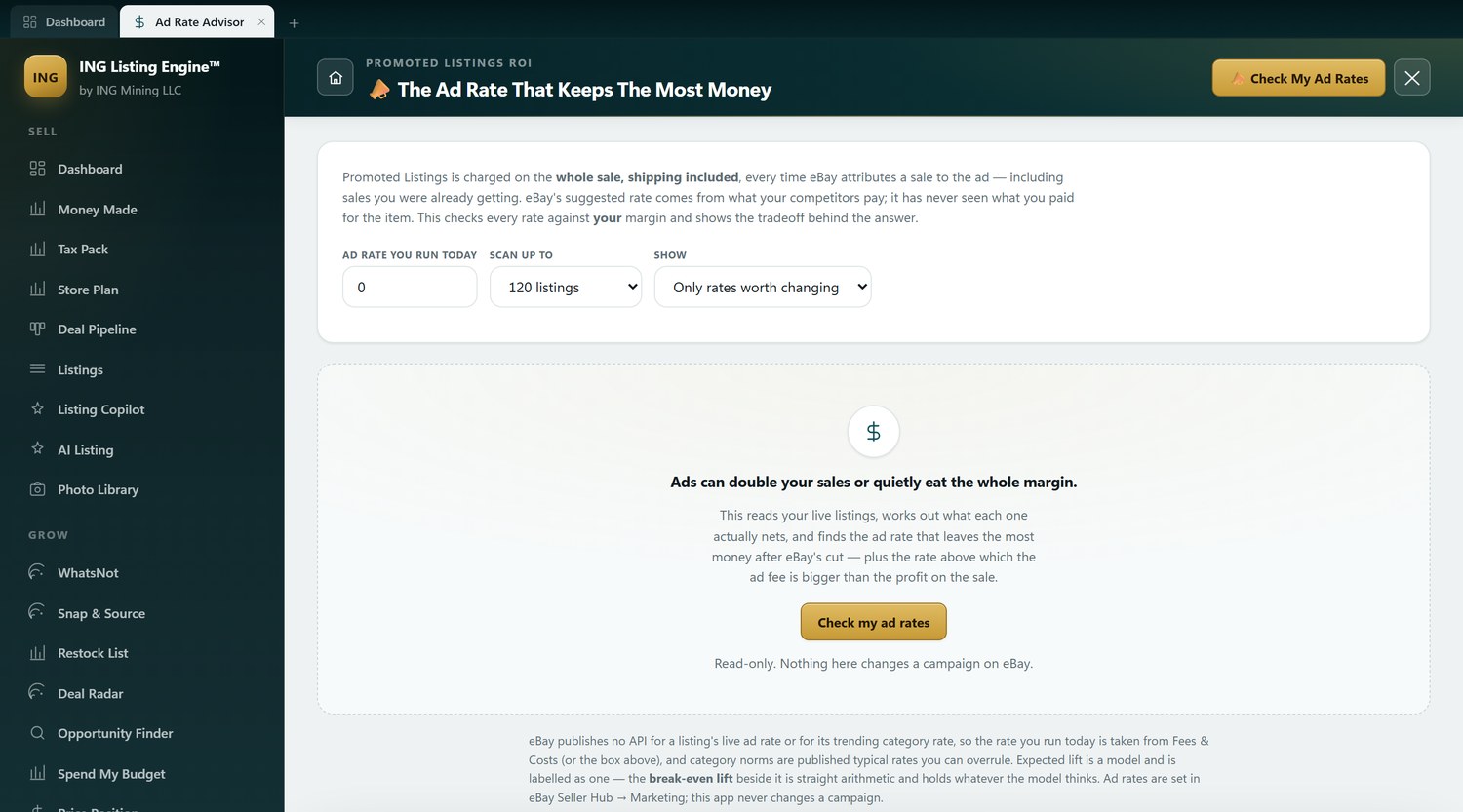
Press the button and it reads your live listings from the connected eBay account. For each one it works out what a sale nets before any ad spend, using the same profit calculator and fee profile as the repricer and the watcher-offer floors — with the ad rate zeroed, so the ad fee is the only thing being varied.
Then it walks every half point from eBay’s 2% minimum upward and builds a ladder. Each rung shows the ad fee per sale, what the sale nets at that rate, the break-even lift, the modelled lift, and the take-home across 100 sales. It recommends the rate that leaves the most money. Per 100 sales rather than per month, deliberately: a listing that has never sold has no monthly rate, and inventing one would put a projection on screen that nothing supports.
Two of those columns are different kinds of number, and the app says so on the screen rather than in a footnote nobody reads:

The modelled lift is exactly that: a model. A saturating curve reaching half its ceiling at the category’s typical rate, on the reasoning that the first points of ad rate buy the most and doubling the rate never doubles the sales. It could be wrong. The break-even lift printed beside it is the formula from earlier on this page, and it holds whatever the model thinks. Side by side, you can see whether a recommendation depends on the model or survives without it. That is the only reason both columns exist.
The category rates it starts from are published and observed typical rates, labelled as estimates everywhere they appear, and you can overrule any of them with the figure your own Seller Hub shows. eBay exposes no API for a listing’s live ad rate or its trending category rate — the same wall the app hits on per-category final value fees, and the reason your own number always beats our table.
It is read-only. It never creates, edits, pauses or ends a campaign. Ad rates are set in Seller Hub under Marketing, and the app does not go there.
When it tells you not to advertise
A tool that recommends spending on every listing is a sales pitch. Six cases where this one refuses:
- No cost basis recorded. It shows what the category rate would cost per sale and stops, because what that costs you depends on a number it does not have.
- No margin. “Don’t advertise this one.” An ad rate multiplies whatever the margin already is, and on a loss it multiplies the loss. The price or the cost has to move first.
- Priced more than 15% over the going rate. Ads put a price buyers are already beating in front of more of them. That is a price problem wearing a visibility problem’s clothes.
- Fewer than three sold comps. The rate is held at the category norm rather than bid above the field on an item nothing confirms people want.
- The gain is trivial. Under about $10 per hundred sales, or less than a percentage point of change, it does not raise it. Churning a campaign for pennies is work, not profit.
- Your own floor. The minimum profit per sale you set in Fees & Costs bounds this exactly as it bounds the repricer, so nobody gets talked past their own limit by a campaign instead of by a price.
Worth saying separately, because it is the cheapest advice on this page: if a listing gets no views at all, ads are the expensive fix. Work through why the listing is not showing and what the title and item specifics are missing first. Those cost nothing, and a promoted listing with a bad title is a bad title you are now paying to show people.
What I can’t tell you
I have no Promoted Listings campaign export. Not a thin one — none. So there is no ninety-days-of-advertising-and-sales-rose-X% claim here, and you should treat that number with suspicion wherever you meet it: either it came from somebody else’s account, in somebody else’s category, at somebody else’s price point, or it was invented. Lift depends on your category, your price against the field, your photos, your seller level and the season. It does not generalise, which is exactly why it is the half of this question that gets written about most and is worth least.
What does travel between accounts is the arithmetic. Break-even lift and the margin ceiling hold on any account in any category, and they rule out most bad ad rates before a penny is spent. For the same fee arithmetic worked on real sold prices rather than illustrative ones, the miner-lot page does it end to end on lots this account actually sold. If a campaign export ever exists here, this page gets the measured half with the method attached. Until then it is mechanics and maths, and it says so.
Common questions
How much does eBay take for a promoted listing?
Whatever ad rate you set, charged on the total amount of the sale — item price plus postage, tax and other applicable fees, the same base eBay uses for final value fees. Rates run from 2% to 100%. On a $220 total sale, a 6% rate is $13.20, and it is charged on top of your normal selling fees, not instead of them.
Are eBay Promoted Listings worth it?
Only when the extra sales beat the fee on the sales you would have made anyway. Work out your break-even lift — c × f / (n − f) — and ask honestly whether ads will deliver it. On a healthy margin with a listing nobody can find, often yes. On a thin margin with a listing that already sells, usually no, because you are mostly paying a percentage on sales you had.
Why can’t I promote my eBay listing?
Most often your seller level: eBay requires Above Standard or Top Rated with enough account activity. The other common reasons are that the listing is an auction rather than fixed price, or the category is not eligible. None of those are fixed by software.
Can you promote auction listings on eBay?
Not with a General campaign — eBay’s requirement names fixed price listings. If the item needs promoting, list it fixed price.
Does the ad fee apply to sales I would have got anyway?
Yes, and this is the part that catches people. If a buyer clicks your ad — including tapping the watchlist heart on it — and buys any of your promoted items within 30 days, the rate is charged. eBay cannot know that buyer would have found you anyway, so that share of your existing sales gets billed. It is why a small ad rate is nowhere near free, and why a listing that already sells well is often the worst one to promote.
How do I turn off promoted listings?
In Seller Hub, under the Advertising tab: end or pause the campaign, or remove individual listings from it. Ending one does not cancel fees already earned on sales inside their attribution window. Our app cannot do it for you — it never touches a campaign.
Want the ladder against your own listings? Download ING Listing Engine — free during the open beta, Windows, no card. Connect your eBay account and the Ad Rate Advisor prices every rate against your real margin. It is read-only on campaigns, so the worst it can do is disagree with you.
Filed under Pricing & Profit · Tagged Fees & margin, Automation · Browse all guides by topic