
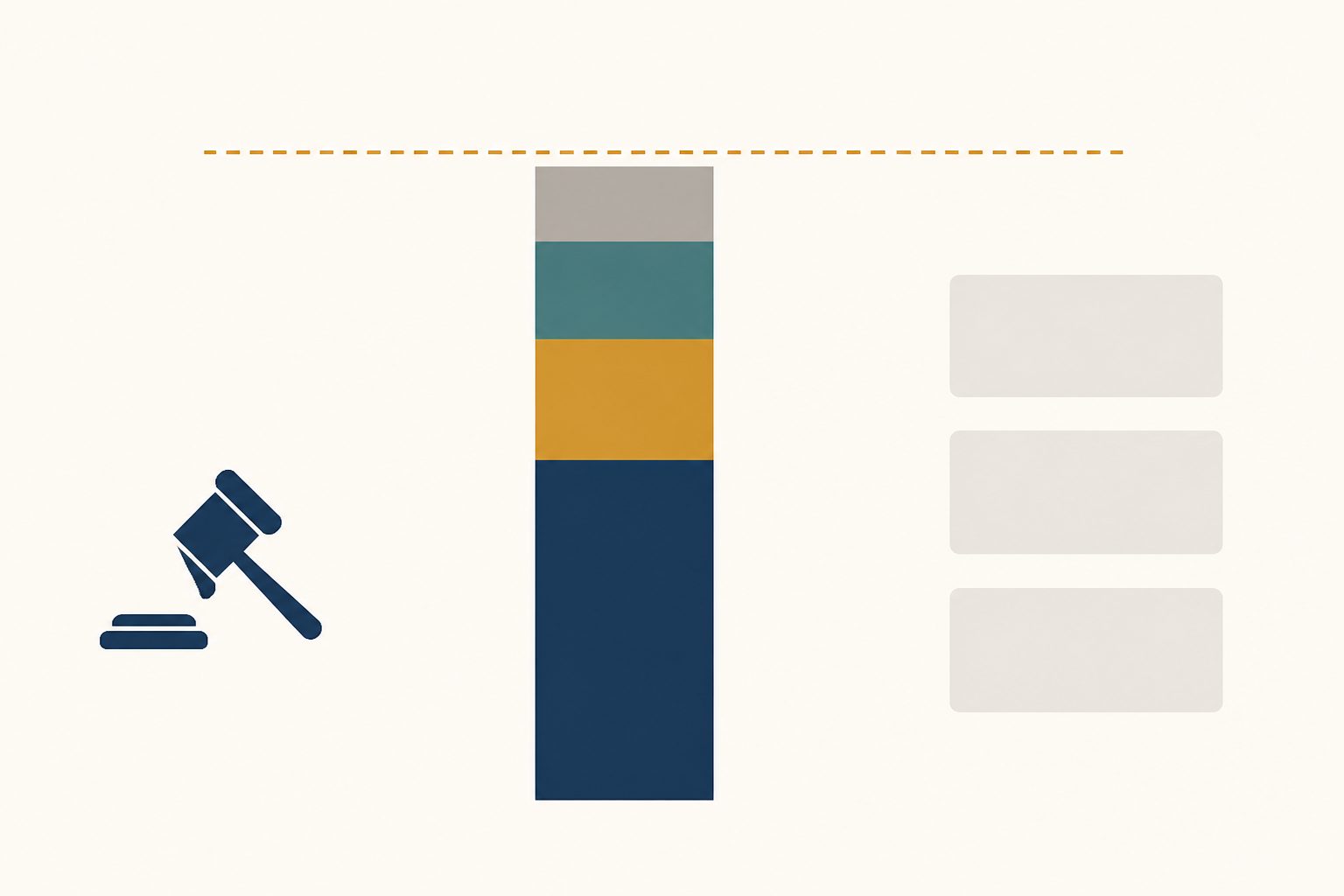
What a Whatnot lot costs you is four numbers, not one: the hammer price, the platform’s buyer-side fee, the shipping, and sales tax. Three of those four land after you have stopped bidding, which is exactly why the bid you can afford is lower than the number in your head when the auctioneer is counting down.
Here is the part most pages about Whatnot fees for buyers will not tell you: I can’t give you Whatnot’s buyer-side rate, and neither can they. The third-party “fee calculator” pages contradict each other flatly — some say there is no buyer platform fee at all, others describe a buyer protection fee and decline to name a percentage. The 8% they all quote is the seller commission, which isn’t your problem when you’re the one bidding. Read the rate off your own last receipt, then use the arithmetic below, which works whatever it turns out to be.
The buyer’s premium has to be divided out, not subtracted
This is the mistake that costs real money, and it is small enough to survive a spreadsheet. A premium is a percentage of the winning bid, so it is not a cost you take off the top — it is a multiplier you have to reverse.
Work it in the right order. Say a thing resells on eBay for about $200, and after eBay’s cut, the box and the label you break even at $120 all-in. You want a 30% return, so your ceiling on total landed cost is $120 ÷ 1.30 = $92.30. Shipping is $12 and is spent whatever you bid, so it comes off the top: $80.30 left for the hammer and the premium together. Now divide, don’t subtract:
max bid = (ceiling − shipping) ÷ (1 + premium)
        = ($92.30 − $12.00) ÷ 1.08
        = $74.35
Illustrative figures, chosen for round numbers. Bid $80.30 because that’s what was “left” and at an 8% premium you actually pay $86.72 — $6.42 past a ceiling you’d already worked out correctly. The order matters twice over: apply the premium before taking the shipping off and you’ve quietly charged yourself premium on the postage, which nobody bills you for.
Keep a second bar in that sum that has nothing to do with percentages. A 30% return on a $200 item is $60, and $60 isn’t worth a night of your time and a box in the garage. The same maximum-bid logic we use on eBay’s own auctions holds a flat cash floor alongside the percentage one and stops at whichever binds first — on cheap lots that’s almost always the cash floor, and raising your target percentage cannot move it.
Shipping is charged per box, not per lot
This one runs entirely one way and it argues against the best buys of the night. A live seller does not post you twelve parcels. They post one box at the end of the show, and charge a first-item rate plus a much smaller rate for every extra thing in it.
So if the rate is $12 first and $1 each after, winning six lots costs you $17 in freight — not $72. Cost every lot at the full $12 and the five after the first all look worse than they are, and the ones it damages most are the cheap ones, where eleven dollars is most of the margin. That is precisely backwards: the second lot from a seller you are already buying from is the cheapest thing on the screen. Budget the first-item rate once and the marginal rate on everything after it.
Sales tax is charged on the hammer plus the premium
A live marketplace in the US is a marketplace facilitator, so it collects your state and local sales tax at checkout and remits it. You do not get to decline it and it is on the same receipt as the hammer price. The rate is set by your delivery address, not the seller’s, so there is no single number to quote — check what your last order was charged.
Two things worth knowing. It is charged on what the platform bills you — the hammer and the premium on it — and not normally on the shipping. And if you hold a resale certificate, buying stock for resale may be exempt; that is worth setting up properly if you are sourcing at any volume, because it comes straight off your landed cost on every lot.
How bidding on Whatnot works, in the seconds you actually get
A lot is on the block for well under a minute and the bidding moves every two or three seconds. That’s the whole problem: you’re not short of arithmetic ability, you’re short of time, and the sold history you’d want to check is on a different site. Whatnot lets you bid live or pre-bid before the lot comes up, and the bidding rises in fixed increments — which matters more than it sounds. If the increment is $5, your ceiling is $73.10 and the bidding is at $70, there is no bid left to make. Pressing takes you to $75.
What our app does with those four numbers today
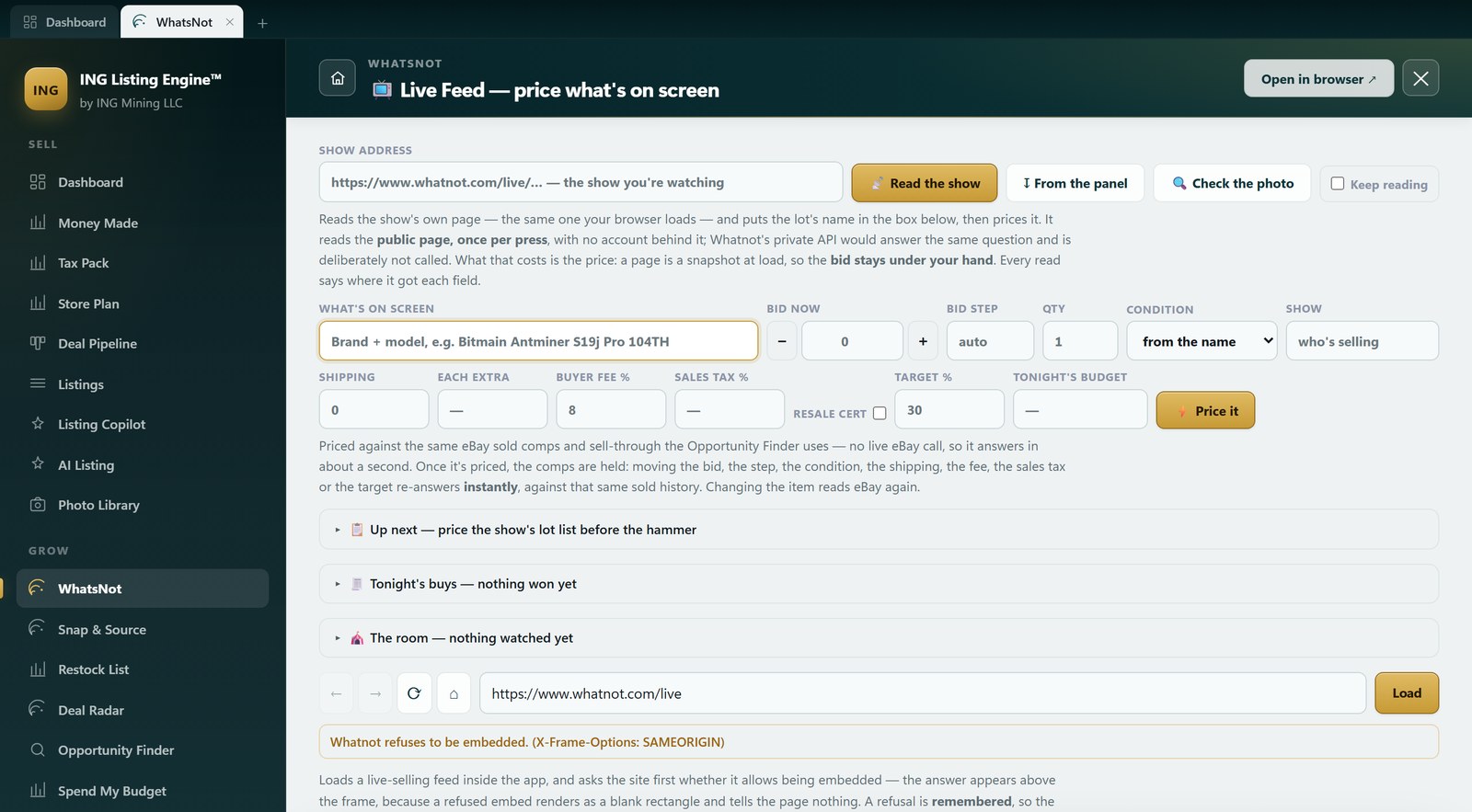
ING Listing Engine has a screen for exactly this, and it is worth being precise about what it does and does not do. You give it the lot — either by typing the name, or by pasting the show’s address so it reads the lot name off the show’s own public page — and it prices it against the same eBay sold comps and sell-through the Opportunity Finder uses, then divides the premium, the tax and the freight back out to give you a maximum bid. It answers in about a second, and once a lot is priced the comps are held, so moving the bid, the step or the condition re-answers instantly without touching the network again.
Around that number it puts the things that decide whether the number is worth acting on: whether eBay will even let you list the thing (replicas and much of what crosses live feeds are banned outright, and a great-looking flip on a listing eBay deletes is a total loss); whether the comps are new units or beaten-up used ones, because a mixed median is the right price for neither; which way those prices have been moving; how many you’d then own and how long that takes to clear; and what’s left of the budget you set for the night. When the lot is “3x Antminer S9” it prices three of them — comps here are per-unit, and treating a multi-unit lot as one item understates the ceiling badly.
It also refuses to flatter you. The ceiling truncates to the cent rather than rounding up, and the sold-comp search shows the words it actually sent to eBay with the junk struck through — because a live host’s lot title is “🔥3x Bitmain Antminer S9 — NO RESERVE!! ships free”, and a keyword search on all of that returns nothing while looking identical to “this has no market”.
What it can’t do, and says so on screen
The app cannot see the stream. An <iframe> cannot read a cross-origin page, and Whatnot refuses to be embedded at all. Plenty of tools would leave you looking at a blank grey rectangle and let you assume the software was broken. This one asks the site for its headers directly and prints the answer:

Three more limits, plainly. It never bids for you — there’s no connection to your Whatnot account and nothing on the screen places or cancels a bid. Every figure is an estimate built from other people’s completed eBay sales, so it’s only as good as the comps behind it, and the screen states how old they are and how far they spread on every card, including the confident ones. And in the current download the lot is named by typing it or by reading the show’s public page — a newer build that reads frames from a shared browser tab landed after the installer on the server was cut, so it isn’t in the file you’d download today.
Is Whatnot worth it for resellers? Honestly, it depends what you sell
I’ll take a position, because the answer isn’t the same for everyone. Live buying works when the comps are dense — cards, sneakers, coins, collectables that trade constantly on eBay in recognisable condition grades. There the sold history is thick enough that a median means something, the items are cheap to post, and buying below market from a room bidding on excitement genuinely works.
For what I actually sell — ASIC miners, servers, industrial automation parts — it’s much harder, and I’d rather say so than sell you a tool. Those comps are thin, a part number matters more than a name, and “MYSTERY MINER LOT” isn’t a search any database can answer honestly. When our own database of completed eBay sales can’t find enough matching sales, the right output is can’t price it, not a confident number.
One more caveat, and it cuts both ways. A room clearing lots at 60% of what the arithmetic says they’re worth is a room where you’ve been bidding to a number you never needed to reach. A room that routinely hammers above your ceiling is one to leave. Neither is a fact about the item, and no amount of eBay sold data will ever contain it.
Whatnot fees for buyers, in one paragraph
Whatever your buyer-side rate turns out to be, cost the lot as hammer + fee + freight + tax, take the freight off before you divide out the fee, charge the first-item shipping rate once rather than on every lot, and set a cash floor as well as a percentage target. If you want that done while the lot is still on screen, the app is a free Windows download during the beta — no card, no account. It’s the same arithmetic you can do with your own receipt and a calculator, and every number you need is on this page. Away from a live show, the same buy-or-pass verdict from a photo or a link covers what you find in the wild, and the money already stuck in stale live listings is usually the larger number anyway.
Common questions
Does Whatnot charge buyers a fee?
Sources contradict each other, and Whatnot’s own help centre does not serve a clean public answer to automated requests — some pages state there is no buyer platform fee and the price you see is the price you pay, others describe a buyer protection fee without naming a rate. The widely-quoted 8% is the seller commission, not a buyer charge. Read the fee line off your own most recent Whatnot receipt and use that; it is the only figure that is definitely true for your account.
Does Whatnot charge sales tax?
Yes, in the US. It acts as a marketplace facilitator, so it collects your state and local sales tax at checkout and remits it, at the rate for your delivery address. It is charged on the hammer price plus any buyer-side fee, and not normally on shipping. If you hold a resale certificate, purchases for resale may be exempt.
How much is Whatnot shipping?
It is set by the seller per show, and the important detail for a reseller is that it is charged per box, not per lot — a first-item rate plus a smaller rate for each additional item shipped together. Costing every lot at the full first-item rate makes every purchase after the first look worse than it is.
How do you set a maximum bid on a live auction?
Work backwards from what the item resells for. Take your break-even landed cost, divide by one plus your target return, subtract the shipping, then divide by one plus the buyer-side fee. That last division is the step people skip, and skipping it makes you overpay by the fee on your entire bid.
Does ING Listing Engine bid on Whatnot for me?
No. There is no connection to your Whatnot account, and nothing in the app places, raises or cancels a bid. It prices the lot and tells you where to stop; pressing the button is yours.
Is Whatnot worth it for resellers?
It works well in categories with dense eBay sold history — cards, collectables, sneakers, coins. It is much weaker for thin-comp categories like industrial and datacentre hardware, where a vague lot name cannot be priced honestly by anyone. Judge it by whether your categories have enough completed sales behind them to make a median meaningful.
Filed under Pricing & Profit · Tagged Fees & margin, Sold comps · Browse all guides by topic