
Putting “VNish” in your eBay title will not, by itself, get you a better price. I can show you the cleanest experiment the sold data contains: one seller moved eleven of the same boosted Antminer S19 95TH between April and July, four titled with the firmware name and seven without. The VNish-titled ones sold at a $138.75 median, the unnamed ones at $149.99. Same machine, same seller, same weeks — the token moved nothing. But ASIC miner firmware still decides what your machine sells for in two quieter ways, and if you’re flashing or selling tuned units you should see the numbers before you write the listing. Everything below comes from our database of completed eBay sales, pulled fresh on 17 August 2026 — including every sale on record that names VNish, Braiins or LuxOS in the title.
Two of those sales are mine. I sell miners on eBay as ingmining, most of my resale S19s ship with VNish on them, and both of my recent firmware-titled sales are sitting in the pull: a 95TH unit with a low-power 2800W tune at $149.99, and a 110TH unit boosted to 120TH at $249.99. So this isn’t a survey of other people’s listings — it’s the market I price against every week, written up the way the guide to selling bitcoin miners on eBay promised someone eventually would.
What ASIC miner firmware sells with on eBay
The three firmware brands are unusually clean search tokens — nothing on eBay is accidentally called “vnish” — so for once the question isn’t a 500-row sample of noise; it’s the entire population. Here is every completed sale in the dataset whose title names each one:
| Title names | Sales on record | Whole single machines | Single median | What the rest is |
|---|---|---|---|---|
| VNish | 47 | 30 | $153.75 | 11 lots ($125–$270/unit), 6 parts & oddments |
| Braiins | 34 | 18 | $168.24 | 10 of the 34 are Braiins’ own BMM 101 mini miner ($75–$239.93); plus BCB 100 control boards at $75–$99 |
| LuxOS | 35 | 33 | $269.97 | Two 2-unit lots. That’s it — no parts, no services |
Those are three different markets wearing firmware names. VNish on eBay is the rack-unit resale trade — S19-family machines between $100 and $250, tuned up or down, mostly from refurb operations like mine. Braiins is half a hardware brand here: almost a third of its rows are the BMM 101, a small lottery miner Braiins sells as a finished product, which has nothing to do with flashing an Antminer. And LuxOS barely appears on standard machines at all — its 33 singles are almost entirely 120V home-conversion builds, which turns out to be the most interesting number on this page. We’ll get there.
Disclosed firmware vs a plain title, like for like
To test whether naming the OS pays, you have to strip the population down to comparable machines: standard-form used units only — no conversions, no hydro, no new-in-box, no lots, no parts. Two model classes have enough sales on both sides to say anything:
| Model class (used, standard form) | OS named in title | Plain title |
|---|---|---|
| Antminer S19j Pro (104TH spec) | $194.99 (n=9) | $151.25 (n=48) |
| Antminer S19 (95TH class) | $150.00 (n=19) | $199.00 (n=21) |
The direction flips between the two rows, which is the finding. If firmware naming were a price lever, it would pull the same way twice. What’s actually happening: on the j Pro, the sellers who name an OS are refurb operations that also test boards, tune profiles and offer a 30-day warranty — the $43.74 premium is the professionalism, and the firmware name is just how you can spot it in a title. On the 95T class, the OS-named units are the cheap end — worked machines from bulk resellers — while the plain-titled set includes hoarded low-hour units listed high. And the four 95T machines that advertised a boost (105TH on a 95TH machine) without naming any OS sold at a $135.00 median, the bottom of every band. A boost with no explanation reads as risk, and buyers price it like one.
Worth one sentence on fees while we’re holding the $43.74: eBay files miners under Coins & Paper Money at a 13.25% final value fee, so even where the disclosed-firmware premium is real you keep $37.94 of it — the full worked fee arithmetic, thresholds and all, lives on the lots-vs-singles page and I won’t re-run it here.
Where firmware actually adds money: the conversion premium
Now the LuxOS number. Those 33 singles at a $269.97 median are almost all the same build: an S19j Pro cut down to roughly 42TH at 975W, rewired for a household 120V outlet, sold as a plug-and-play home miner. Against the $151.25 plain j Pro median, buyers are paying 78% more for 40% of the hashrate. The wider converted-and-hydro class tells the same story across both model families — a $262.48 median on j Pro conversions (n=30) and $394.50 on 95T-class conversions (n=14), against $150-ish standard machines.
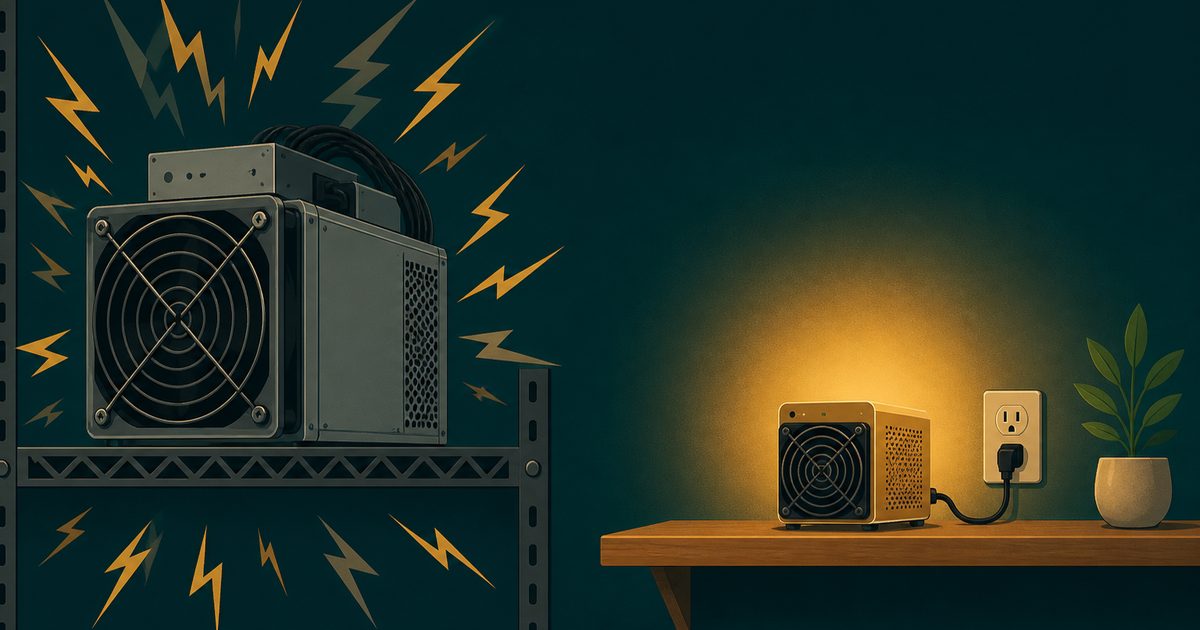
The firmware is genuinely load-bearing in that build — per-board power targets are what let a 3,068W machine idle along at 975W on a 15A circuit without cooking itself — but notice what the buyer is paying for: quiet, and a wall plug. The outcome, not the software name. If you have the bench skills, converting is worth far more than tuning; if you don’t, the honest takeaway is that flashing VNish onto a rack unit and relisting it is not a value-add strategy, it’s table stakes in a crowded refurb market. Either way, price the machine off its class band, not off a $/TH figure — why price-per-terahash fails is its own article.
What to disclose when you sell a flashed machine
Everything above says the market won’t pay you extra for the firmware name. So why do I put it in every title? Because disclosure isn’t a price play — it’s a returns play. A tuned machine that surprises its buyer comes back, and on a 35-lb box the return postage alone eats the margin (the heavy-equipment shipping guide has those numbers). Here’s the checklist I actually use, from listings that have sold and stayed sold:
- Name the OS and the tune profile — hashrate and watts at the wall. My sold format: “95TH/s | Low Power 2800W Tune | VNiSH Firmware”. The wattage matters as much as the terahash; plenty of buyers are on 30A circuits and the 2800W number is why they picked my unit.
- Title the machine at its Bitmain spec, and the boost as a boost. The convention that works is “S19 105TH/s BOOSTED — 95TH”: the model is what Bitmain made; the extra 10TH is the tune. Claiming the boosted figure as the machine’s spec is the kind of surprise that comes back in a box.
- Say the dev fee out loud. Aftermarket firmware pays its developers with your buyer’s hashrate: VNish states a 2–2.8% dev fee and Braiins OS a 2–2.5% fee, rebated to zero if you mine on Braiins Pool (both read 17 August 2026; LuxOS publishes no percentage on its firmware page). On a 104TH j Pro, 2.8% is about 2.9TH mining for someone else — your buyer will find that on day one, so it should be in the description on day zero.
- Say whether it flashes back to stock. The S19 family restores to factory firmware from an SD card in about ten minutes, and a sentence saying so answers the question half your watchers came to ask. If the unit is somehow locked — hosting-contract firmware, unknown passwords — that is not a footnote, that is the listing’s first line, and if a seller won’t say it, that’s the scam signal to walk away from as a buyer.
- Photograph the dashboard. A screenshot of the actual hashrate chart at the actual wattage beats every adjective. Warranty honesty belongs here too: a secondhand S19 is years out of Bitmain warranty regardless of firmware, so the only warranty that exists is the one you offer — and it earns its title space: the sale sitting right at the OS-named j Pro median, $194.99, carries “30 Day Warranty” in the same 80 characters.
All of that has to fit an 80-character title, which is a genuinely annoying packing problem — model, hashrate, wattage, condition, firmware, in descending order of what buyers search for. It’s also exactly the kind of grunt work I built ING Listing Engine to do: it drafts miner titles and prices against these same sold comps, and the Windows app is free to download while it’s in beta.
Questions people ask about miner firmware and resale
Does custom firmware void an Antminer warranty? Flashing third-party firmware voids what remains of a Bitmain warranty, but on the secondhand market this is mostly moot: S19-family machines are years past their factory coverage. The warranty that actually protects an eBay buyer is the seller’s own return window, so state yours explicitly instead of leaning on Bitmain’s.
Should I flash a miner back to stock firmware before selling it? Not necessarily. Disclosed tuned machines sell fine — nine OS-named S19j Pros median $194.99 against $151.25 for plain titles — and the S19 family restores to stock from an SD card in minutes, so say the tune and say it’s reversible. What sells worst is a boosted machine with no explanation: 95TH units advertising 105TH with no OS named sold at a $135.00 median, the bottom of the band.
Does VNish or Braiins OS increase a miner’s resale value? The firmware name alone doesn’t. One seller sold the same boosted S19 eleven times, four titled VNish at a $138.75 median and seven untitled at $149.99. The premium in the data sits with refurb sellers who disclose a full tune profile, test the boards and offer a warranty; the firmware name is a marker of that work, not a price lever by itself.
What is a dev fee, and does the buyer of a used miner pay it? Aftermarket firmware redirects a slice of the machine’s hashrate to its developers: VNish states 2 to 2.8 percent and Braiins OS 2 to 2.5 percent, rebated to zero on Braiins Pool, as of 17 August 2026. Yes, the buyer inherits it — a 2.8 percent fee on a 104TH machine is about 2.9TH mining for the developer — which is exactly why a listing should name the firmware it ships with.
Why do converted 110V home miners sell for more than stock machines? Because they solve the two problems that keep ordinary people from running a rack miner: a 240V circuit and 75-decibel fans. eBay buyers paid a $269.97 median for 42TH-at-975W wall-plug conversions against $151.25 for untouched 104TH machines — 78 percent more for 40 percent of the hashrate. The premium is the outlet and the silence, with firmware power-limiting doing the enabling work.
Filed under Reselling Hardware · Tagged ASIC miners, Sold comps, Dirty data · Browse all guides by topic