
Across the whole machines in our own sold-comp database, the ASIC miner price per terahash runs from $1.09 to $2.31 — and one segment sells at $14.75. Same algorithm, same manufacturer, largely the same generation of silicon. A unit of measure that moves 13× across the thing it’s supposed to measure isn’t a unit. It’s a habit. If you’re selling Bitcoin miners on eBay, pricing off $/TH is the fastest way to leave money on a good machine and overprice a bad one.
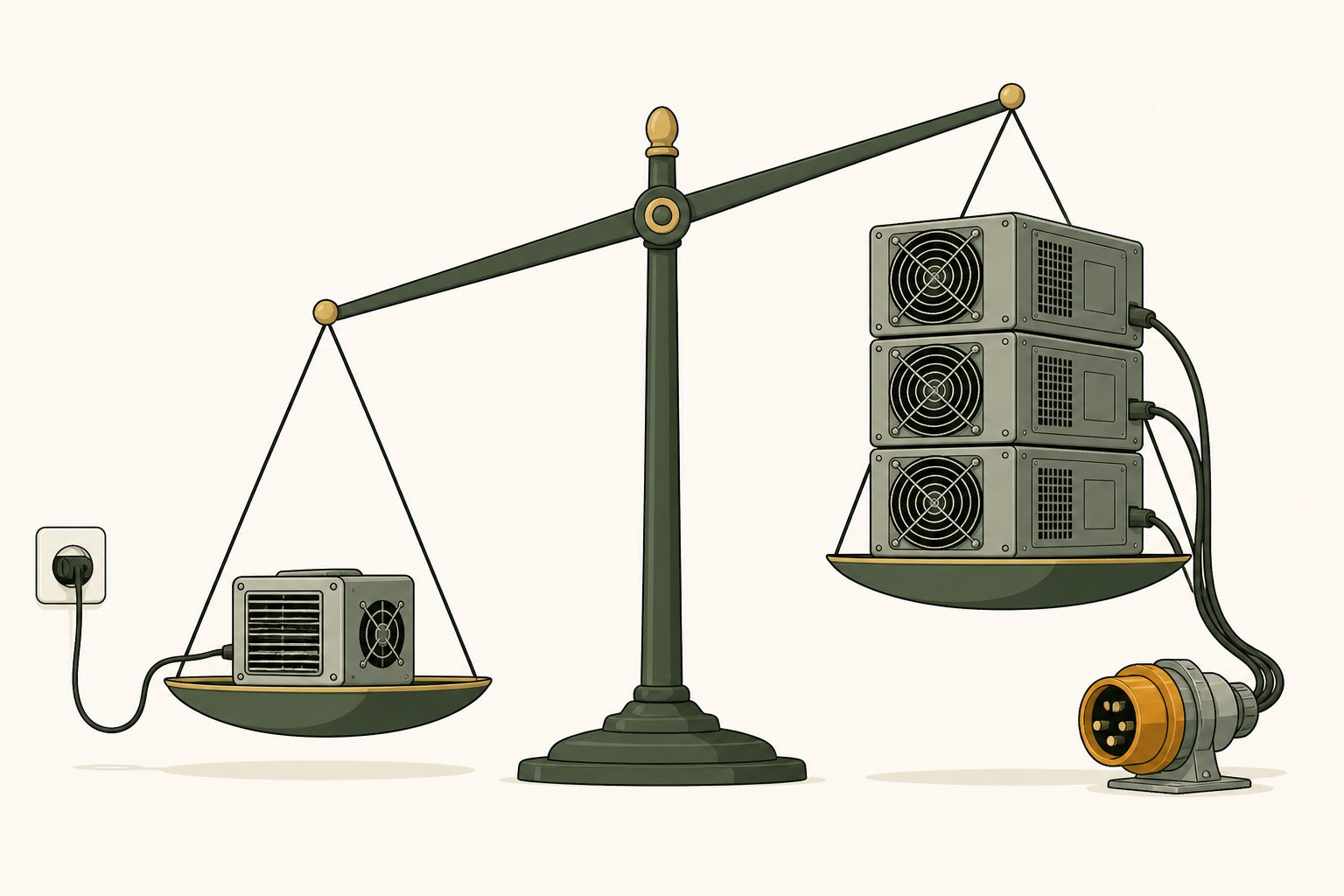
One small machine on a household outlet outweighing three big ones. That is not a metaphor — it is what the sold prices below actually say.
What whole machines actually sold for
Every figure here comes from our own database of 864,000 sold records, collected through 2026-07-17. Method, because it matters more than the numbers: query the shortest distinctive token, pull a 500-row sample, then filter locally to rows that contain both the brand and the model, and drop hashboards, control boards, PSUs, fans, cases, lots, repairs, firmware and hosting contracts. What survives is whole machines only.
| Model | Spec | J/TH | Whole units | Median | $/TH |
|---|---|---|---|---|---|
| Antminer S19 XP (full-spec) | 141 TH @ 3010 W | 21.5 | 38 | $325.50 | $2.31 |
| Antminer S19 (95T) | 95 TH @ 3250 W | 34.2 | 7 | $150.00 | $1.58 |
| Antminer S19j Pro | 104 TH @ 3068 W | 29.5 | 18 | $117.50 | $1.13 |
| Antminer S19 Pro | 110 TH @ 3250 W | 29.5 | 4 | $119.99 | $1.09 |
| Whatsminer M30S | 88 TH @ 3344 W | 38.0 | 5 | $200.00 | $2.27 |
| Antminer S21 | 200 TH @ 3500 W | 17.5 | 1 | $999.00 | — |
| Whatsminer M50 | 114 TH @ 3306 W | 29.0 | 1 | — | — |
Spec hashrate and wattage are the manufacturer’s published figures, not anything derived from the sales — Bitmain rates the S19 XP at 21.5 J/TH and both the S19 Pro and S19j Pro at 29.5 J/TH. The last two rows are in the table to be honest about what a single sale is worth, which is nothing. More on those below.
The most expensive terahash on eBay is a deliberately crippled one
Inside that S19 XP bucket sit five listings that break the whole exercise. They’re S19 XPs converted to run on a normal household outlet — throttled to roughly 40 TH/s and a few hundred watts, quiet enough for a spare room, sold with WiFi bolted on. They went for $579.99, $579.99, $589.99, $679.99 and $699.99.
A full-power S19 XP — all 141 TH of it — has a median of $325.50 in the same sample. So the derated machine, doing under a third of the work, sells for roughly 1.8× the money. Per terahash that’s $14.75 against $2.31: 6.4× for the same box with most of its chips turned down.
Nobody is confused. They’re buying what they can plug in. A stock S19 XP wants a 240 V circuit, pulls 3 kW continuously and runs at about 75 dB — that rules out every apartment and most houses. The 500 W conversion sits next to a desk. Hashrate isn’t the product. Being able to run it is the product.
Efficiency explains the direction, not the size, of the gap
The two best-sampled models behave the way theory says they should. The S19 XP at 21.5 J/TH sells for $2.31/TH; the S19j Pro at 29.5 J/TH sells for $1.13/TH. Roughly 1.4× the efficiency, roughly 2× the price per terahash — which makes sense, because efficiency is the only thing that decides how long a machine stays profitable as difficulty climbs. Buyers pay a premium for the machine that dies last.
Then the Whatsminer M30S ruins it. Least efficient machine in the table at 38 J/TH, and it posts $2.27/TH — level with the S19 XP. With n=5 and a range of $20 to $329 that number carries no weight, and I’d rather say so than build a theory on it. The honest reading: efficiency sets the direction within a product family, and outside that it gets swamped by supply, condition and how many are being dumped at once.
Only two of these models can be priced at all
This is the part most pricing guides skip. Out of seven models, exactly two — the S19 XP (n=38) and the S19j Pro (n=18) — have enough clean whole-machine sales to state a median with a straight face. Everything else is n=7 or worse, and two are n=1.
The failures are instructive, and they’re the same failure the Terapeak alternatives comparison documents at length: the comps API OR-matches tokens, so a model number that is also a common product code drags in everything. Of 500 rows returned for antminer s21, 223 contained “s21” and only 14 contained “antminer” — the rest were Samsung Galaxy S21 cases, Garvee SAC12-2-S21 air conditioners and a Notch Marvin S21 pole-saw blade. Exactly one whole S21 survived, at $999. For whatsminer m50, 67 rows carried “m50” and 16 carried “whatsminer”: Canon EOS M50 camera bags, a Sansui P-M50 turntable, AVON M50 gas-mask amplifiers. The one row that made it through the filter turned out to be a four-pin fan listing, so the M50 has no price here at all.
The filter leaks in both directions, and it’s a word rule, not intelligence. Two “COMPLETE CASE” listings sat in the derated bucket at $129.99 and $139.99 until I added “case” to the exclusions — an empty chassis being averaged in with working miners. Assume anything you compute this way is 5–10% contaminated and size your confidence accordingly.
What the keyword average would have told you
For contrast: the raw API average across all 1,743 records matching antminer s19 is $685.43. The cleaned median for a full-spec S19 XP is $325.50. Price off the first number and you list at more than double the market, sit for four months, and then take an offer you’d have been thrilled with on day one. That’s the same trap the repricing walkthrough is built around, and it starts here, at the pricing stage, not at the discount stage.
antminer s19 average $685.43. A full-spec S19 XP’s cleaned median is $325.50. The difference is what is sitting in the pile: in the S19j Pro pull alone, 24 of the excluded rows were bare control boards.How to actually price one
- Identify the exact variant first. S19, S19 Pro, S19j, S19j Pro, S19 XP and S19K Pro are six different machines and their medians span $117.50 to $325.50. “S19” on its own is not a model.
- Pull sold comps, then throw most of them away. Hashboards, control boards, PSUs and fans dominate the results for every miner — in the S19j Pro pull, 24 of the excluded rows were control boards alone. A comp set you haven’t cleaned is measuring spare parts.
- Use the median and the 10th–90th band, never the mean. Full-spec S19 XP: median $325.50, p10 $242.50, p90 $455.00. That band is your listing range. The top row in that same pull was a $7,000 Bitmain Antminer Z15 Pro — a Zcash miner, wrong algorithm entirely, dragged in by the token match. A mean absorbs that. A median shrugs.
- Price the power envelope, not the hashrate. 240 V and 3 kW is a smaller market than 120 V and 500 W. If yours is a derated home conversion, that is the headline and it’s worth multiples.
- Only then sanity-check $/TH — as a smell test against machines of the same model and configuration. Never across models, and never across power envelopes.
Where a $/TH rule of thumb does earn its keep
Two places, and they’re both worth being fair about. Buying new gear from a vendor, $/TH is a legitimate comparison — the machines are identical, warranted, and quoted at the same moment, so the only variables are hashrate and price. And at farm scale, where you’re placing hundreds of units into a site with a fixed power budget, $/TH and J/TH together are exactly the right lens. ASIC Miner Value is genuinely better than we are at that job: it tracks new-machine pricing and break-evens across the whole market, which our sold-comp scrape doesn’t attempt. Farm-scale buyers also tend to buy by the pallet rather than the machine, which changes the price you can ask — three Antminer S21 lots cleared $933 to $999 a unit against the single $999 comp in the table above, while older S19s lost about 8% a unit. What a miner is worth inside a lot covers that split.
It stops working the moment you’re selling one used machine to one buyer on eBay. So does any rule that ignores the freight: on a $349 machine the median seller charges $50 to ship a machine that heavy, which is 14% of the sale before eBay takes its share of that too. At that point you’re not selling terahashes. You’re selling a specific unit, in a specific condition, to someone with a specific electrical situation.
Put the constraint in the title
Every one of those five expensive conversions says 110V 120V in the title. That’s the qualifying question answered before the buyer clicks, and eBay’s search can only match what’s in the text. If your machine is stock, give the voltage and wattage anyway — it filters out the buyer who’d have opened a not-as-described case when 3 kW tripped their breaker. Same logic for firmware, which the miner selling guide covers in detail: disclose the tune because it changes what the machine draws, not because it earns a premium — the firmware resale study has since put numbers on exactly that. Getting those attributes into the title and item specifics consistently is what AI listing software is genuinely good at, once you’ve decided the price yourself.
Buying rather than selling? The mirror of all this is the ceiling calculation in the auction-sniping guide — the same cleaned comps, run backwards to find the most you can pay.
Doing this without running the queries yourself
All of the above is manual: pull the comps, strip the parts, take the median, check the band. ING Listing Engine does the cleaning pass for you — free Windows app, open beta. It matches your item against sold comps, discards the hashboards and lots automatically, and prices off what’s left instead of a keyword average. It also says when the match is too thin to trust, which — as the S21 and M50 rows show — is more often than anyone selling a pricing tool likes to admit.
Common questions
What is a good price per terahash for a used ASIC miner? There isn’t a single figure, which is the problem with the metric. Across cleaned whole-machine sales in an 864,000-record sold-comp database, full-power S19-family miners ranged from $1.09/TH (Antminer S19 Pro, median $119.99) to $2.31/TH (Antminer S19 XP, median $325.50). Derated 120-volt home conversions of that same S19 XP sold at $14.75/TH. Use $/TH only to compare machines of the same model and configuration.
Why do derated 110V home miners sell for more than full-power ones? Because buyers pay for what they can plug in. Five Antminer S19 XP units converted to run at roughly 40 TH/s on a household outlet sold for $579.99 to $699.99, against a $325.50 median for the same machine at its full 141 TH/s. A stock S19 XP needs a 240-volt circuit, draws about 3 kW continuously and runs near 75 dB, which excludes most homes. The throttled version runs at a few hundred watts beside a desk, so its buyer pool is far larger.
How do I price a used Antminer S19 XP on eBay? Use the median and the 10th-to-90th-percentile band of cleaned sold comps, not the mean. For full-spec 141 TH/s units that is a median of $325.50 with a band of $242.50 to $455.00. Identify the exact variant first — S19, S19 Pro, S19j, S19j Pro, S19 XP and S19K Pro are six different machines whose medians span $117.50 to $325.50.
Should I price off the average sold price eBay shows me? No. The raw average across all 1,743 records matching the phrase ‘antminer s19’ is $685.43, while the cleaned median for a full-spec S19 XP is $325.50 — more than double. Keyword matching pulls in hashboards, control boards, power supplies, fans, lots and, in one case, a $7,000 Antminer Z15 Pro Zcash miner running a different algorithm entirely.
Why can’t I find reliable sold prices for a newer miner like the S21? Not enough clean sales exist yet, and the model number collides with unrelated products. Of 500 rows returned for ‘antminer s21’, 223 contained the token ‘s21’ but only 14 contained ‘antminer’ — the rest were Samsung Galaxy S21 cases, Garvee air conditioners and a pole-saw blade. Exactly one whole S21 survived the clean, at $999. One sale is not a price.
Does a more efficient miner sell for more per terahash? Within a product family, generally yes: the Antminer S19 XP at 21.5 J/TH sold at $2.31/TH against the S19j Pro at 29.5 J/TH and $1.13/TH. Efficiency decides how long a machine stays profitable as difficulty rises, so buyers pay up for the one that dies last. The relationship breaks across families — the Whatsminer M30S is the least efficient machine measured at 38 J/TH and still posted $2.27/TH, though on only five sales.
Filed under Reselling Hardware · Tagged ASIC miners, Sold comps, Fees & margin, Dirty data · Browse all guides by topic